0


- Home
- Blog
- Sports Applications
- Pickleball Eyewear: ASTM F3164, Lenses & Protection Guide
Pickleball Eyewear: ASTM F3164, Lenses & Protection Guide
Pickleball and Racquet Sports Eyewear: Standards, Lenses, and What Protection Really Means
Pickleball has grown faster than almost any sport of the past few years, and its eye injuries have grown with it. Play happens at close range, at the net, with a hard ball driven off a solid paddle. Players react in fractions of a second and often can’t get out of the way.
That’s created a crowded market for “pickleball glasses,” and much of it doesn’t protect anyone. For brands building in this category, the difference between a sunglass and an eye protector is the whole product.
Sunglasses Are Not Eye Protectors
A normal sunglass is designed to reduce light and block UV. It isn’t designed to stop a ball. Under a direct hit, a fashion lens can shatter or pop out of the frame and into the eye, and a thin frame can be driven into the face.
A racquet sports eye protector is built and tested so the lens stays in place, the frame doesn’t collapse into the eye, and the wearer’s eye is shielded from a direct ball strike. Words like “impact resistant” on a product page don’t mean it has passed that test.
The Standards: F803 and F3164
This is where the market is confused, and where getting it right sets a brand apart.
For years, racquet sports eye protection was tested under ASTM F803, a broad standard covering eye protectors for several sports. Racquet sports provisions were later moved into a dedicated standard, ASTM F3164, and its current revision, ASTM F3164-24, now explicitly covers pickleball alongside racquetball, squash, and tennis. It sets requirements for both non-prescription and prescription eye protectors.
Many products and retail guides still cite F803 for pickleball. If you’re developing a pickleball protector now, design and test to the current racquet sports standard. Confirm the current edition with your testing lab before certifying, as standards are revised. Our certification guide covers how protection claims change which standard applies.
The same principle as our safety eyewear guide applies here: if you claim protection, you need to test for it.
Designing for Impact
Products that pass racquet sports impact testing share a few traits:
- Polycarbonate lenses of sufficient thickness, for impact strength
- Secure lens retention, so the lens can’t be pushed out of the frame toward the eye
- A frame that holds its shape under impact rather than collapsing inward
- Coverage around the eye, often with wrap geometry, so a ball can’t get between frame and face
- Comfortable, stable fit, since a protector that’s pushed up on the forehead protects nothing
Frame material and geometry matter as much as the lens. Our frame geometry guide covers how coverage and wrap are engineered.
Lenses: Indoor, Outdoor, and Tracking the Ball
Pickleball is played both indoors and outdoors, and the lens needs differ:
- Indoor: clear or very light lenses. Gyms and indoor courts don’t need tint, and a dark lens slows ball tracking.
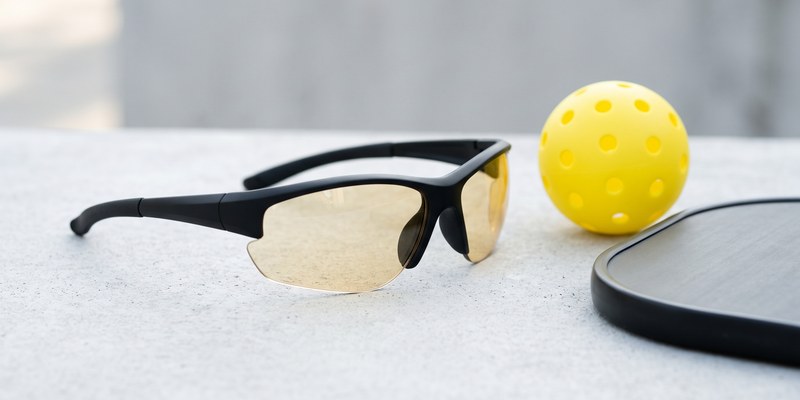
- Outdoor: Category 2 lenses suit most conditions, with contrast tints such as amber, copper, or rose to help pick out a bright ball against the court and sky.
- Both: photochromic lenses suit players who move between indoor and outdoor courts, and interchangeable lenses let one frame serve both.
On polarization: it isn’t needed for most pickleball, and it can make reading a ball’s spin against a bright surface harder for some players. It’s a reasonable option for outdoor play in strong glare, but not a requirement. Our lens selection guide covers the trade-offs.
Fit, Comfort, and Fog
Pickleball involves quick lateral movement, lunges, and sudden stops, so the frame has to stay put:
- Light weight and good balance, so the frame doesn’t shift on quick movements
- Grippy nose pads and temples, or a strap option for more intense play
- Ventilation, since indoor courts can be warm and protectors sit close to the face. Our anti-fog guide covers design and coating.
A Broad Player Base
Pickleball players range from children to retirees, and that shapes a product range:
- Prescription compatibility matters, since many players need vision correction. A protector worn over glasses (OTG) or with a prescription insert serves this group. Our prescription eyewear guide covers the options.
- Smaller fits for youth players, with the durability and sizing points covered in our kids’ eyewear guide
- Style matters, since many players want protective eyewear that looks like performance sunglasses rather than lab goggles
Be Careful With Claims
Because the category is growing fast, it attracts loose marketing. A product sold as “pickleball glasses” or “impact resistant” without testing to the racquet sports standard can mislead buyers about protection it doesn’t provide. For a brand, that’s both a safety issue and a liability one.
Market protection only if the product has been tested and certified for it, and state which standard it meets. If a product is a performance sunglass rather than a certified protector, say so clearly.
Specification Checklist
For a pickleball or racquet sports line, define:
- Protective eyewear (certified) or performance sunglass (not certified)
- Target standard and edition, confirmed with your lab
- Lens material, thickness, and retention design
- Indoor, outdoor, or both, and the lens range for each
- Photochromic or interchangeable option
- Fit, weight, and retention features
- Ventilation and anti-fog
- Prescription compatibility
- Youth sizing
Where Tony Optical Fits
We manufacture sports eyewear and protective products with in-house injection molding, polycarbonate lens production, and our own testing laboratory. For a racquet sports line, we can design the frame and lens retention for impact, run pre-certification testing before you commit to a certification lab, and advise on lens options for indoor and outdoor play.
Frequently Asked Questions
What standard applies to pickleball eye protection?
ASTM F3164-24 is the current standard for racquet sports eye protectors and now includes pickleball. Many products still cite the older ASTM F803. Confirm the current edition with your testing lab.
Are sunglasses enough for pickleball?
Ordinary sunglasses aren’t designed to stop a ball and can break or be pushed into the eye. Eyewear certified to the racquet sports standard is designed for that.
What lens is best for pickleball?
Clear or very light lenses indoors. Outdoors, a Category 2 contrast tint such as amber, copper, or rose helps track the ball. Photochromic suits players who use both.
Should pickleball glasses be polarized?
It isn’t necessary. Polarization can help in strong outdoor glare, but some players find it makes reading the ball harder.
Can I get prescription pickleball glasses?
Yes. The racquet sports standard covers prescription protectors, and over-the-glasses designs or prescription inserts serve players who need correction.
What does “impact resistant” mean on pickleball glasses?
On its own, very little. Look for a stated standard the product has been tested to.
Final Thoughts
Pickleball’s growth has created real demand for eye protection, and also a market full of products that only look protective. Brands that test to the current racquet sports standard, state it clearly, and design lenses and fit for how the game is actually played will earn trust in a category where most products haven’t.
Developing pickleball or racquet sports eyewear? Get in touch with our team to discuss impact design, lens options, and certification.