0


- Home
- Blog
- Lens Technology
- Interchangeable Lens Sunglasses: Systems, Retention & Design
Interchangeable Lens Sunglasses: Systems, Retention & Design
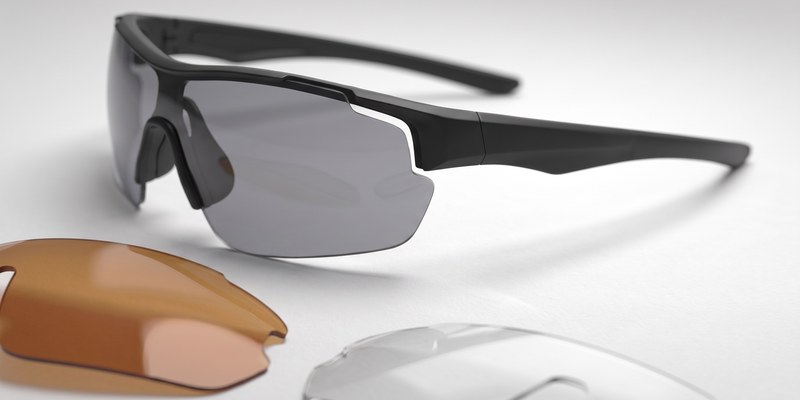
Interchangeable Lens Systems: How Swappable Sports Eyewear Actually Works
Every sport-specific lens recommendation eventually runs into the same wall: no single tint works across every condition an athlete encounters. A cyclist riding from dawn into midday, a skier moving between bluebird and flat light, an angler fishing inshore then offshore — one lens is always a compromise somewhere.
Interchangeable lens systems resolve that by letting the wearer swap lenses in seconds. They’re also one of the harder things to engineer well, and one of the easiest to specify badly.
The Commercial Case
Before the engineering, the business logic, because it’s what usually justifies the development cost:
- Higher average selling price. A multi-lens kit commands significantly more than a single-lens frame.
- Ongoing lens revenue. Replacement and additional lenses sell to existing customers at good margin.
- One frame, several markets. The same tooling serves bright-condition, low-light, and specialist buyers.
- A genuine reason to buy premium. Interchangeability is a feature customers understand immediately, unlike most optical specifications.
The counterweight is complexity: more SKUs, more inventory, more packaging design, and a frame that costs more to tool.
The Retention Mechanisms
Groove and friction retention. The lens seats into a channel in the frame and is held by the frame’s own elasticity. It’s the simplest and cheapest approach, adds no components, and keeps a clean appearance. The trade-off is that swapping requires flexing the frame — which demands a material with reliable memory and leaves room for the user to flex it the wrong way.
Mechanical clips and latches. Dedicated catches lock the lens in place. Retention is positive and predictable, and the user gets clear tactile feedback that the lens is seated. It adds components, cost, and visible hardware.
Magnetic retention. Magnets embedded in frame and lens hold the assembly, usually with a locating feature to set position. Swapping is fast and satisfying, which is why premium products favour it. The engineering tension is real though: magnets strong enough to survive impact can be hard to separate by hand, and magnets weak enough to swap easily may release on a knock. Magnets also add weight and cost, and must be fully encapsulated — a loose magnet is a serious hazard, and more so in any product reaching children.
Hybrid systems combine magnetic location with a mechanical catch, getting the speed of one and the security of the other. It’s the most robust of the conventional approaches, and the most expensive.
Lever-actuated release. Rather than relying on hand force to overcome retention, a lever mechanically disengages it. This is a structurally different solution, and we’ll come back to why it matters once the underlying problem is clear.
The Real Engineering Problem: Tolerance
Here’s what separates a system that works from one that frustrates customers.
A conventional interchangeable lens has to satisfy two contradictory requirements. It must be secure enough that it never releases under impact, vibration, or a fall. And it must be loose enough that an average person can remove it by hand, outdoors, possibly in gloves, without tools.
The window between those is narrow, and three tolerance stacks eat into it: the frame groove dimension, the lens edge dimension, and the dimensional change both undergo across temperature. A system designed at room temperature can bind in cold conditions or loosen in heat — which matters, since the sports most likely to use interchangeable lenses are the ones conducted in temperature extremes.
Too tight, and users crack lenses forcing them in. Too loose, and lenses eject on the first impact. Both generate returns, and both trace back to tolerance decisions made at the design and tooling stage.
Why a Lever Changes the Equation
The contradiction above exists for one reason: in a friction, clip, or magnetic system, the same force that holds the lens in place is the force the user must overcome to remove it. Make retention stronger and swapping gets harder. There is no way to improve one without degrading the other.
A lever-actuated system breaks that link. The lever mechanically disengages the retention, so holding force and removal effort become independent variables. Retention can be specified for impact security without making the lens harder to remove, because the user is operating a mechanism rather than fighting it.
The practical consequences:
- No force required. Swapping doesn’t depend on grip strength, and the user never flexes the frame or the lens.
- No lens stress during swap. The most common cause of broken lenses in interchangeable products is the user bending them during removal. A lever eliminates that handling entirely.
- Consistent across temperature. A mechanism is far less sensitive to the thermal dimensional changes that make friction systems bind in cold or loosen in heat.
- Glove and cold-weather operable, which matters for exactly the alpine and winter products most likely to need lens changes.
This is the approach behind our own patented lever-release interchangeable lens system, developed in-house and documented among our registered patents. It was engineered specifically to resolve the security-versus-ease trade-off rather than balance it.
The Failure Mode Nobody Tests
Most specifications cover impact, optical quality, and UV. Very few cover swap cycle durability — and it’s where interchangeable systems actually fail in the field.
Every swap works the retention geometry slightly. Over a season, a groove wears, a clip loses its snap, a magnet’s locating feature rounds off. A system that feels perfect on the first swap can be unacceptably loose by the hundredth.
If you’re developing an interchangeable product, specify a target swap count and test to it. It’s a simple addition to a quality control programme and it catches a failure that would otherwise surface as warranty claims twelve months after launch.
Two related points worth testing:
- Edge stress during swap. The lens edge is where force concentrates during insertion and removal. Edge finish quality directly affects how many cycles a lens survives — and systems that remove manual force from the swap reduce this wear considerably.
- Optical repeatability. The lens must seat in the same position every time. A system that allows slight rotation or offset between swaps changes the optical alignment, which in a wrapped high base curve lens is enough to be noticeable.
Designing for the User, Not the Engineer
A factory technician can swap any lens correctly. A customer in a cold car park cannot.
Design decisions that reduce support complaints:
- Make the wrong method difficult. If users can flex a lens in a way that cracks it, some will. Geometry should guide the correct action — or remove the opportunity altogether.
- Provide tactile or audible confirmation. A click tells the user the lens is seated. Silence invites a half-seated lens.
- Keep handling away from the optical zone. Grip points at the lens edge, not the centre, reduce smudging and scratching.
- Consider glove operation for snow and cold-weather products.
- Include clear instructions in the kit. Obvious to you, not to the buyer.
Material and Lens Considerations
Material pairing matters more here than in a fixed-lens frame. In a friction-retained system a rigid frame with a rigid lens leaves no compliance — something has to flex, and if neither does, the lens cracks. Frames using these systems generally need a material with dependable elastic memory, which is one reason TR90 and nylon both appear in this category. Mechanically released systems relax that constraint, widening the material options available to a designer.
Lens side, polycarbonate is standard, and the lens options a system offers are a product decision in themselves. A typical three-lens kit covers bright conditions, variable light, and low light — mapped to the conditions your target sport actually encounters, as covered in our lens selection by sport guide. A related architecture is the prescription insert, which solves a different problem using similar mounting engineering.
What to Decide Before Tooling
Interchangeability cannot be retrofitted. The retention geometry is in the mold. Settle these first:
- Retention mechanism and target swap force
- Target swap cycle count
- Lens count and tints in the kit
- Temperature range the system must work across
- Spare lens SKU strategy and packaging
- Whether prescription inserts also need to mount
Where Tony Optical Fits
We develop and manufacture interchangeable lens sports eyewear, including our own patented lever-release system — a mechanism that lets the wearer change lenses quickly and without force, while keeping retention specified for impact rather than for finger strength.
With in-house injection molding, lens production, and our own testing laboratory, we can validate retention across temperature and swap durability to a real cycle count before a product reaches production. For brands developing a lens system, those are the decisions that determine whether customers enjoy the feature or return the product.
Frequently Asked Questions
How do interchangeable lens sunglasses stay in place?
Through groove friction, mechanical clips, magnets, hybrid systems, or a lever-actuated mechanism. Each trades ease of swapping against retention security — except lever systems, which separate the two.
What is a lever-release lens system?
A mechanism where a lever disengages the lens retention, so the user doesn’t rely on hand force. Because holding force and removal effort are independent, the lens can be held securely while still swapping easily.
Are magnetic lens systems secure enough for sport?
They can be, but magnet strength is a genuine trade-off against swap ease. Hybrid and lever systems address that trade-off more directly.
How many times can lenses be swapped?
It depends on the design, and it’s rarely specified. Set a target cycle count during development and test to it, because retention wear is the most common long-term failure.
Can interchangeable lenses be added to an existing frame?
No. Retention geometry is part of the mold, so it must be designed in from the start.
Do interchangeable systems work in cold weather?
Friction-based systems are sensitive to thermal dimensional change and can bind in cold. Mechanically released systems are considerably more consistent across temperature.
Final Thoughts
Interchangeable lens systems are among the few eyewear features customers can explain back to you, which makes them commercially powerful. They’re also unforgiving: the difference between a system people enjoy using and one they complain about comes down to tolerances and cycle durability decided long before the first production run — or to a mechanism that removes the trade-off altogether.
Developing an interchangeable lens product? Get in touch with our team to discuss retention design, swap durability targets, and our lever-release lens system.