
 0


- Home
- Blog
- Industry Insights
- Kids’ Sunglasses Manufacturing: UV, Sizing & Safety Guide
Kids’ Sunglasses Manufacturing: UV, Sizing & Safety Guide
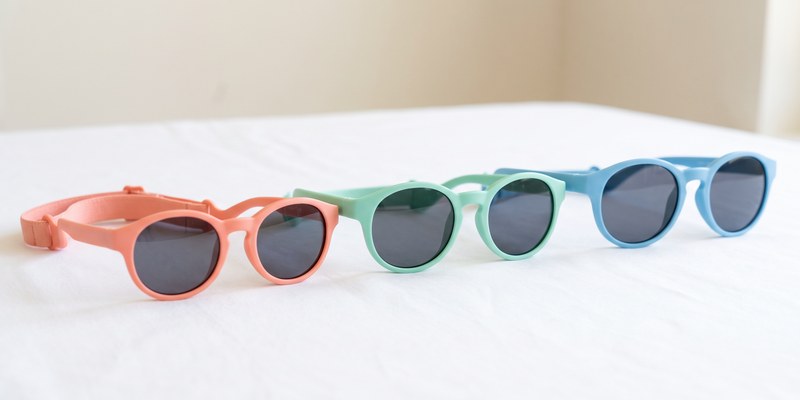
Children’s Eyewear: Why Kids’ Sunglasses Are Not Scaled-Down Adult Frames
The quickest way to get children’s eyewear wrong is to treat it as an adult frame at eighty percent scale. Children’s faces are proportioned differently, their eyes are optically different, they treat products in ways adults don’t, and the person buying is not the person wearing.
For brands and retailers entering this category, here’s what actually changes.
UV Protection Matters More, Not Less
This is the part worth understanding properly, because it drives the whole product.
An adult’s crystalline lens yellows gradually with age, and in doing so it filters out a portion of incoming ultraviolet light before it reaches the retina. A child’s lens is clearer, so more UV reaches the back of a child’s eye than an adult’s. Combine that with the amount of time children spend outdoors, and a substantial share of a person’s lifetime UV exposure occurs before adulthood.
The practical consequence for a product specification: UV400 is not a premium feature in children’s eyewear — it’s the baseline requirement. Any children’s sunglass worth putting your name on blocks UVA and UVB fully, and you should be able to evidence it with transmittance data rather than a sticker.
The Hazard Most Buyers Don’t Know About
Here is the point that separates a serious children’s product from a novelty one.
A dark lens without proper UV filtering is worse than no sunglasses at all. The dark tint reduces visible light, which causes the pupil to dilate — and a wider pupil admits more ultraviolet light to the retina than an unshaded eye would. The child looks protected and is measurably less protected.
This is why cheap novelty children’s sunglasses are a genuine concern rather than a quality complaint, and why UV verification belongs in your testing programme rather than in your supplier’s assurances. If you take one specification away from this article, it’s that tint darkness and UV protection are independent properties, and in children’s eyewear the gap between them is a safety issue.
Which Standards Apply — and the Classification Trap
Children’s sunglasses are generally covered by the same sunglass standards as adult products — in Europe, EN ISO 12312-1:2022 (amended 2024); in the US, FDA impact requirements alongside ANSI Z80.3.
The trap is classification. A product intended as a toy — costume eyewear, play accessories, novelty items for very young children — can fall under toy safety requirements such as EN 71 instead of, or in addition to, sunglass standards. The two regimes test different things: toy safety is concerned with small parts, mechanical hazards, and chemical migration, while sunglass standards are concerned with optical performance and UV.
Getting this classification wrong means testing to the wrong requirement entirely. Decide early what your product is, and confirm the applicable regime for each target market. Our certification guide covers the broader compliance picture.
Also worth noting: lens category selection still applies. A Category 3 lens suits bright outdoor conditions, while Category 4 is generally inappropriate for general children’s use and carries driving restrictions.
Sizing: Not Just Smaller
Children’s facial proportions differ from adults’ in ways that matter to frame geometry:
- A lower, flatter nose bridge. This is the single most common fit failure. An adult bridge geometry scaled down still sits too high and slides straight off.
- Shorter temple-to-ear distance relative to face width.
- Proportionally wider faces relative to length.
- Rapid change with age. A frame that fits a three-year-old fits nobody at seven.
That last point drives product strategy more than brands expect. Children’s ranges usually need at least two or three age bands rather than one universal size — commonly a toddler fit, a young child fit, and a junior fit — and the differences between them are proportional, not just linear scaling.
For the youngest band, retention is a product requirement rather than an accessory: flexible wrap-around temples or an adjustable strap are standard, because toddlers remove things.
Durability and Safe Construction
Children’s eyewear gets dropped, sat on, chewed, and thrown. Design accordingly:
- Flexible, impact-resistant materials. TR90 and other flexible polymers suit this category well — they bend and recover rather than snapping. Our material comparison covers the options.
- Polycarbonate lenses, for impact resistance.
- No sharp edges or points anywhere on the frame.
- Secure component retention. Small detachable parts are a choking hazard for young children — nose pads, temple tips, and lens retention need to hold under deliberate abuse, not just normal wear.
- Hinge design that tolerates over-flexing, or hingeless construction for the youngest band.
- Material safety. Children mouth products. Confirm the material and any coatings meet the chemical requirements of your markets.
These belong in your quality control criteria explicitly, because “passes adult inspection” is not the same bar.
The Buyer Is a Parent
Children don’t buy sunglasses; adults buy them, usually for a child who may resist wearing them. That shapes what sells:
- Protection is the purchase driver. Parents buy on UV claims, so substantiate them clearly.
- Comfort determines whether it gets worn. An uncomfortable children’s frame ends up in a drawer, which makes comfort a protection feature.
- Durability is value. Parents replacing frames every month stop buying the brand.
- Appearance matters to the child. The adult pays, but the child decides whether to wear it. Colour and style affect compliance, not just appeal.
- Clear sizing guidance by age reduces returns — one of the biggest cost drivers in this category.
Where Tony Optical Fits
We manufacture children’s sunglasses alongside our sports and lifestyle ranges, with in-house injection molding, lens production, and our own testing laboratory for UV transmittance and impact validation.
For brands developing a children’s range, that means we can verify UV performance rather than assert it, advise on age-band sizing and retention design before tooling, and supply the certification documentation your markets and retailers require. Our OEM/ODM process covers children’s products the same way it covers performance eyewear.
Frequently Asked Questions
Do children need sunglasses more than adults?
A child’s crystalline lens is clearer than an adult’s and filters less ultraviolet light, so more UV reaches the retina. Combined with time spent outdoors, that makes proper UV protection particularly important in childhood.
Are dark lenses without UV protection dangerous for children?
Yes. A dark tint causes the pupil to dilate, and without UV filtering that admits more ultraviolet light to the eye than wearing nothing. Tint darkness and UV protection are separate properties.
What UV rating should children’s sunglasses have?
UV400, blocking UVA and UVB, verified by transmittance testing rather than by label alone.
Do children’s sunglasses follow toy safety standards?
It depends on classification. Genuine sunglasses generally fall under sunglass standards such as EN ISO 12312-1, while products intended as toys may fall under toy safety standards such as EN 71. Confirm which applies before testing.
How many sizes does a children’s range need?
Usually two or three age bands. Children’s facial proportions change quickly, and scaling one frame up or down does not produce a good fit across ages.
What material is best for kids’ sunglasses?
Flexible impact-resistant polymers such as TR90 for frames, with polycarbonate lenses. Flexibility matters because children’s eyewear is bent rather than handled carefully.
Final Thoughts
Children’s eyewear is a category where the specification genuinely matters and where the cheapest products on the market can be actively counterproductive. Brands that verify UV performance, design for real children’s proportions, and build for abuse produce something parents re-buy. Those that scale down an adult frame and add bright colours produce something that ends up in a drawer.
Developing a children’s eyewear range? Get in touch with our team to discuss UV verification, age-band sizing, and durability for your collection.

Article Classification
Recent Articles
- Kids’ Sunglasses Manufacturing: UV, Sizing & Safety Guide
- Safety Eyewear Manufacturing: Developing an Industrial PPE Line
- Safety Eyewear Manufacturing: Developing an Industrial PPE Line
- Sunglasses Certification: Compliance Requirements by Market
- How to Start Your Own Sunglasses Brand: MOQ, Costs & Timeline