0


- Home
- Blog
- Sports Applications
- Golf Sunglasses: Lens Tint, Green Reading & Fit Guide
Golf Sunglasses: Lens Tint, Green Reading & Fit Guide
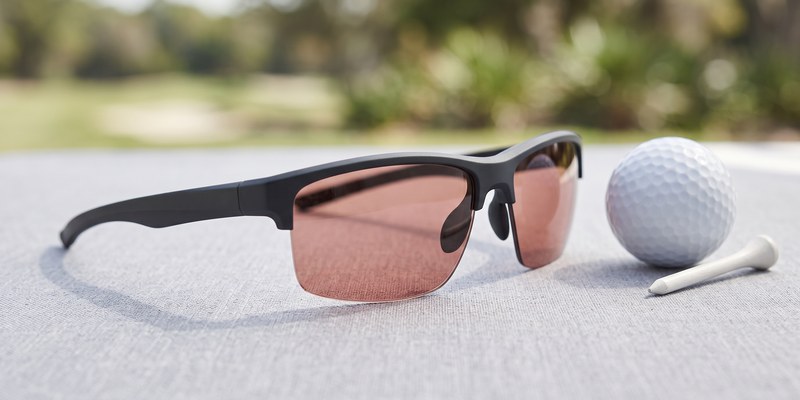
Golf Eyewear: Specifying Lenses and Frames for Reading Greens and Tracking the Ball
Golf asks different things of eyewear than most sports. There’s no speed, no impact from the ground, little sweat compared with running. But a round lasts four or five hours in open sun, and the visual tasks are unusually precise: following a small white ball against a bright sky, then reading subtle slope and grain on a green.
A frame and lens built for cycling or running often gets those tasks wrong. Here’s what golf actually requires.
The Two Visual Tasks
Golf eyewear has to serve two very different jobs, often on the same hole:
Tracking the ball. A white ball against blue sky or cloud, at a distance, moving fast. Contrast between ball and background is what lets a golfer follow it to its landing spot.
Reading the green. Judging slope, grain, and texture on a surface that is mostly one colour. This depends on subtle shading and surface detail.
The right lens has to help with the first without hurting the second. That’s why lens choice in golf is more debated than in most sports.
Contrast Tints for Ball Tracking
Tints that warm the image and sharpen contrast against sky and grass are the most common golf choice:
- Rose and copper add contrast and depth, and help pick out the ball against sky
- Amber and brown improve definition on grass and in variable light
- Neutral grey keeps colours accurate and suits very bright conditions, but adds less contrast
Several golf-specific lens tints are designed to emphasise green and reduce blue haze, using the same selective filtering approach described in our guide to contrast-enhancing lenses. As always, ask for transmittance data rather than relying on a tint name.
A Category 2 lens suits most golf conditions, with Category 3 for very bright courses. A lens that’s too dark makes ball tracking harder, not easier.
The Polarization Question
Polarization divides golfers more than any other lens feature.
The case against: polarized lenses remove reflected glare, and on a green, some of that reflected light carries information. The sheen on grass shows grain direction and subtle undulation. Many golfers find polarization flattens the green and makes it harder to read, which is why many golf-specific lenses are deliberately non-polarized.
The case for: polarization cuts glare from water hazards, wet fairways, and cart paths, and reduces eye strain over a long round in bright sun.
The practical answer for a brand is that there’s no single correct choice, so offering both, or an interchangeable lens system, serves the market better than picking one. Our lens selection guide covers the general trade-offs.
Photochromic lenses suit golf well: a round can start early in low light and finish in full afternoon sun, and changing lenses between holes isn’t practical.
Frame Design: Look at the Bottom of the Lens
In cycling, the rider looks up through the top of the lens, so the upper rim is the problem, as covered in our cycling eyewear guide.
In golf it’s the opposite. At address, the golfer looks down at the ball, and that sightline runs through the bottom of the lens. A full lower rim sits right in the line of sight at the moment that matters most.
This drives three specifications:
- Rimless or semi-rimless lower edge, so nothing crosses the view of the ball
- Adequate lens depth at the bottom, so the golfer looks through the lens rather than under it
- Pantoscopic tilt and frame geometry that keeps the optical zone where the eye goes when looking down
Optical quality also matters more than in many sports. Golf depends on judging distance and line, and a lens with distortion, especially in a wrapped frame, can subtly mislead both.
Comfort Over a Long Round
Five hours of wear makes comfort a performance factor:
- Light weight, since pressure on the nose and ears builds over a round. Our running eyewear guide covers weight reduction in detail
- Stable fit through the swing, with grippy nose pads and temples that don’t shift as the head turns
- Cap and visor compatibility, since most golfers wear one
- Moderate wrap rather than an aggressive shield, which suits golf’s lower speed and lifestyle look
Golf Is Also a Lifestyle Category
Golf eyewear is often worn off the course as well, and the golf market tends to be older and more style-conscious than many sports. That changes design priorities: frames lean towards versatile shapes that look right at the clubhouse as well as on the tee. Very aggressive shield designs sell less well here than in cycling.
The demographic also brings higher prescription demand. Many golfers need correction, and some need it for reading scorecards and devices, so prescription compatibility is worth considering early. Our prescription eyewear guide covers the options.
Specification Checklist
For a golf line, define:
- Lens tint range, with transmittance data
- Polarized, non-polarized, or both
- Photochromic option
- Rimless or semi-rimless lower edge
- Lens depth and tilt for looking down at address
- Weight target for all-day wear
- Cap and visor compatibility
- Style direction for on- and off-course wear
- Prescription compatibility
Where Tony Optical Fits
We manufacture sports eyewear for golf and other performance categories, with in-house injection molding, lens production, and our own testing laboratory. For a golf line, that means we can advise on contrast tint and polarization options, engineer the lower frame and lens depth for the address position, and verify optical quality before production.
Frequently Asked Questions
Should golf sunglasses be polarized?
It’s a genuine split. Polarization cuts glare from water and wet grass, but many golfers find it flattens greens and makes grain harder to read. Many golf-specific lenses are non-polarized for that reason.
What lens tint is best for golf?
Rose, copper, and amber add contrast for tracking the ball and reading grass. Grey suits very bright conditions. A Category 2 lens fits most rounds.
Why do golf sunglasses have rimless bottoms?
Because golfers look down through the bottom of the lens at address. A lower rim would sit right in the view of the ball.
Are photochromic lenses good for golf?
Yes. A round can run from low morning light into bright afternoon sun, and photochromic lenses adjust without needing a lens change.
Can you see the ball better with tinted lenses?
Contrast tints such as rose and copper help pick out a white ball against sky and cloud. A lens that’s too dark makes it harder.
Do golf sunglasses come in prescription versions?
They can. Golf has high prescription demand, and frames can be designed for direct glazing or prescription inserts.
Final Thoughts
Golf eyewear succeeds on details that don’t matter much elsewhere: a clear view through the bottom of the lens, a tint that tracks the ball without hiding the green, and comfort over five hours. Brands that design around how golfers actually look at the ball build products that earn a place in the bag.
Developing a golf eyewear line? Get in touch with our team to discuss contrast tints, lens options, and frame design for the course.