0
0


- Home
- Blog
- Lens Technology
- Polarized vs Photochromic Lenses: Best Choice by Sport
Polarized vs Photochromic Lenses: Best Choice by Sport
Polarized vs Non-Polarized vs Photochromic: Choosing Sports Lenses by Discipline
Ask three athletes which lens is best and you'll get three answers — because they're playing different sports. A lens that transforms fishing can actively work against a mountain biker. One that's perfect for a road cyclist in changing light is the wrong call for a golfer reading a green.
For brands specifying a sports eyewear line, this is where product decisions get made or missed. Here's how polarized, non-polarized, and photochromic lenses actually differ in the field — and which discipline each one belongs to.
The Three Options, Briefly
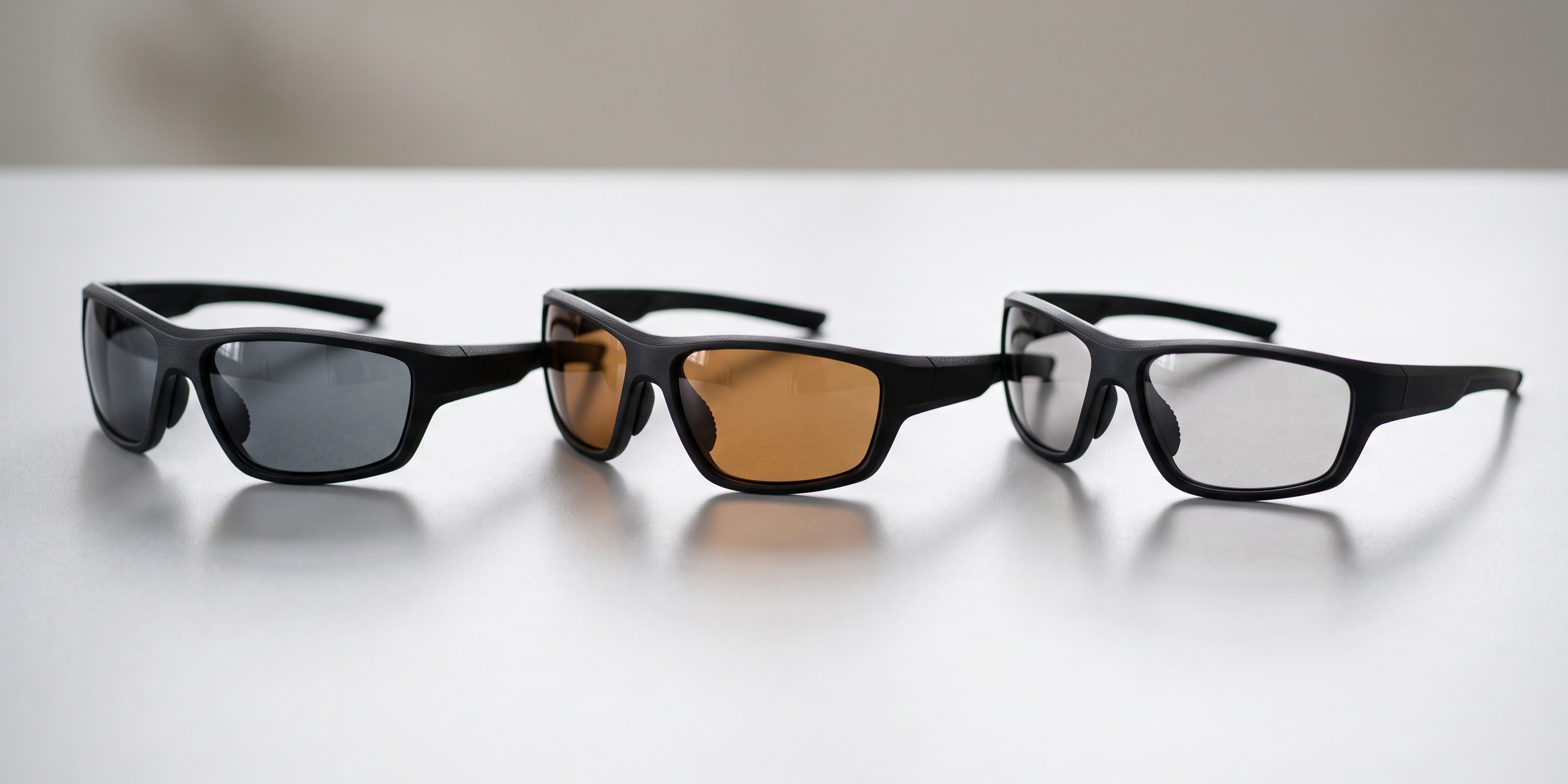
Polarized lenses contain a filter that blocks horizontally reflected light — the harsh glare bouncing off water, wet roads, snow, and car hoods. The effect is dramatic: contrast improves, eye strain drops, and on water you can suddenly see beneath the surface instead of a mirror.
Non-polarized lenses are tinted without that filter. They reduce overall brightness and can enhance contrast through tint choice, but they leave reflected glare intact — which, counterintuitively, is sometimes exactly what an athlete needs.
Photochromic lenses react to UV light, darkening in bright sun and clearing in shade or indoors. One pair covers a range of conditions instead of forcing a swap.
For the underlying optical fundamentals — lens materials, coatings, and UV protection — our earlier guide covers the technical groundwork. This article focuses on matching lens type to sport.
Where Polarization Wins — and Where It Backfires
Polarization is the most oversold feature in eyewear, marketed as a universal upgrade. It isn't. It's a specialized tool that's transformative in some sports and a liability in others.
It wins decisively on water and flat reflective surfaces. Fishing is the clearest case — cutting surface glare lets anglers see structure, fish, and depth. Boating, kayaking, paddleboarding, and beach sports benefit for the same reason. Driving and motorsport gain from reduced road and windshield glare.
Where it causes problems:
- Reading screens. Polarized filters can make LCD displays dim or black out at certain angles — a real issue for cyclists watching a bike computer, or any athlete using a device mid-activity.
- Reading terrain. Mountain bikers and trail runners often rely on subtle reflections to spot wet rock, roots, and loose surfaces. Removing that glare removes information.
- Spotting ice. Some skiers and snowboarders prefer non-polarized precisely because reflections help reveal icy patches that polarization can mask.
- Reading greens. Many golfers find polarization flattens the surface texture cues they use to judge grass and slope.
The takeaway for a brand: polarization is a feature to specify deliberately by model, not to apply across an entire range by default.
Where Photochromic Earns Its Premium
Photochromic lenses solve a different problem: changing light, not glare.
They're strongest wherever conditions shift mid-activity — trail running and mountain biking that alternate between dense forest and open sun, long road rides that start at dawn, ski days where cloud rolls in and out, and hiking that spans exposed ridge and shaded valley.
The honest limitations matter too:
- Transition takes time. Darkening and clearing aren't instant, so very abrupt light changes can briefly outpace the lens.
- Windshields block activation. Most car glass filters UV, so a standard photochromic won't darken fully while driving.
- Temperature affects behavior. Transition speed and maximum darkness vary with ambient temperature.
- Peak darkness is limited. A photochromic at its darkest generally won't match a dedicated dark fixed tint.
It's also worth noting that photochromic and polarized aren't mutually exclusive — combined lenses exist and suit variable-light watersports well, at a higher cost.
Don't Overlook Lens Category (VLT)
Lens type is only half the specification. Visible Light Transmission — how much light reaches the eye — is classified under EN ISO 12312-1 into five categories:
| Category | VLT | Suited to |
|---|---|---|
| 0 | 80–100% | Indoor, very low light, clear protective lenses |
| 1 | 43–80% | Overcast, dawn/dusk, light shade |
| 2 | 18–43% | Variable and moderate sunlight |
| 3 | 8–18% | Bright sun — the general-purpose sunglass range |
| 4 | 3–8% | Extreme glare: high altitude, glaciers, open water |
One critical compliance point: Category 4 lenses are not permitted for driving. If your line includes a glacier or high-altitude model, it needs the correct marking — worth confirming with your manufacturer's testing lab before production, not after.
Quick Reference: Lens Choice by Sport
| Sport | Recommended | Why |
|---|---|---|
| Fishing / watersports | Polarized | Cuts surface glare; reveals detail below water |
| Road cycling | Photochromic | Handles dawn-to-midday light shifts; keeps screens readable |
| Mountain biking | Photochromic, non-polarized | Forest-to-open transitions; preserves terrain reflections |
| Trail running | Photochromic, lighter category | Variable canopy light; low weight matters most |
| Road running | Non-polarized, Cat 2–3 | Simplicity and comfort over long distances |
| Skiing / snowboarding | Photochromic or Cat 3–4 | Changing weather; many prefer non-polarized to spot ice |
| Golf | Non-polarized, contrast tint | Preserves surface texture cues for reading greens |
| Racquet sports / pickleball | Non-polarized, contrast tint | Fast ball tracking; indoor-outdoor variation |
| Driving / motorsport | Polarized (with screen caveat) | Reduces road and windshield glare |
Treat this as a starting framework rather than a rulebook — athlete preference varies, and the best-selling spec in one market isn't always the best-selling spec in another.
What This Means for Your Product Line
The practical implication for brands is that lens selection should be made model by model, tied to the discipline each frame targets:
- Build sport-specific SKUs rather than applying one lens spec across the range
- Reserve photochromic for premium tiers, where its cost is justified by genuine versatility
- Consider interchangeable-lens models for disciplines with wide condition ranges
- Confirm the correct category marking and compliance for every market you sell into
A manufacturer with in-house lens capability can help you build a coherent range across price points — rather than picking from whatever a lens trading company happens to stock.
Where Tony Optical Fits
We manufacture sports eyewear across polarized, non-polarized, and photochromic specifications, with lens production and coating handled in-house and every run validated in our own testing lab. That means we can advise on lens spec by discipline — and confirm your lenses meet the certification requirements of your target markets before mass production begins.
Final Thoughts
There's no best lens — only the best lens for a specific sport, in specific conditions, at a specific price point. Brands that spec lenses by discipline build ranges that athletes trust. Brands that apply one lens across everything end up with products that are adequate everywhere and excellent nowhere.
Developing a sports eyewear line? Get in touch with our team to discuss lens specification for your target disciplines and markets.