0
0


- Home
- Blog
- Lens Technology
- Prescription Sports Eyewear: RX Inserts vs Direct Glazing
Prescription Sports Eyewear: RX Inserts vs Direct Glazing
Prescription Sports Eyewear: RX Inserts, Direct Glazing, and What Wrap Frames Can Actually Do
A significant share of athletes need vision correction, and most sports eyewear ignores them. The reason isn’t indifference — it’s that the geometry making a sports frame work is the same geometry that makes prescription lenses difficult.
For a brand, prescription compatibility is a real market opportunity and a real engineering constraint. Here’s what’s actually possible, what it costs, and how to decide before you commit to tooling.
Why Wrap Frames Resist Prescription Lenses
A standard spectacle lens sits roughly perpendicular to the line of sight, in a frame with a shallow 4-to-6 base curve. The optics are straightforward.
A sports frame at 8 base curve or higher wraps steeply around the face. That creates three compounding problems:
Prismatic effect. As a lens curves away from the visual axis, it induces prism — objects appear subtly displaced from where they actually are. In a plano lens this is correctable through design. Add a prescription and the effect interacts with the correction itself.
Oblique astigmatism. Light entering a steeply angled lens off-axis produces aberration that degrades clarity, worsening toward the periphery and with stronger prescriptions.
Power shift across the lens. The effective prescription changes as the lens curves, so the correction a wearer gets looking straight ahead differs from what they get looking to the side.
The result is that a prescription simply surfaced into a wrap lens, without compensation, can cause eye strain, distorted peripheral vision, or genuine nausea. Properly made wrap prescription lenses require compensated designs — calculations accounting for base curve, wrap angle, pantoscopic tilt, and vertex distance to deliver the intended correction in actual wearing position.
This matters commercially: it’s lab-dependent work, and the quality of the result varies more between labs than most brands expect.
The Three Approaches
Direct glazing. Prescription lenses are surfaced and cut directly into the frame. It gives the cleanest appearance and best field of view, with no extra component.
The constraints are real. Prescription range is limited — stronger corrections become impractical at high base curve, and strong astigmatism compounds the difficulty. It requires compensated lens designs and a lab capable of producing them. And lens thickness at the edges can become significant in a wrap, affecting both appearance and fit into the frame groove. Direct glazing works best for mild to moderate prescriptions in frames at 6 base rather than 8.
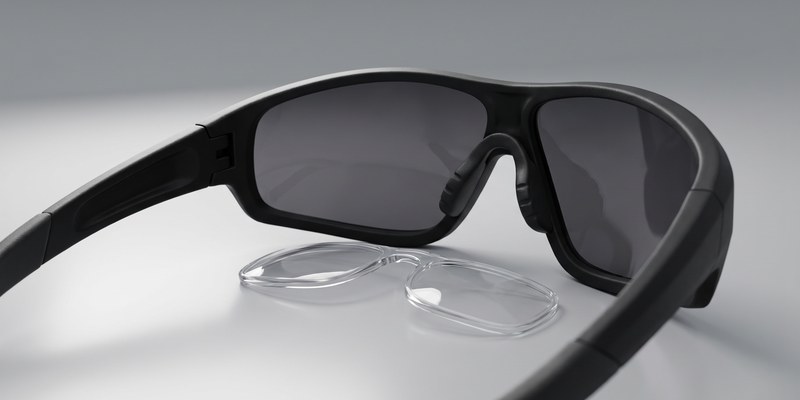
RX inserts. A small separate prescription carrier mounts behind the main lens, inside the frame. The outer lens stays a standard plano sports lens.
This is the most common solution in performance eyewear for good reason. The insert sits at a conventional angle, so the optics are straightforward and a much wider prescription range is supported. It works with aggressive wrap geometry, lets the wearer keep interchangeable outer lenses, and can be replaced as a prescription changes without replacing the frame.
The trade-offs: a narrower corrected field of view (peripheral vision goes through the uncorrected outer lens only), two surfaces that can fog or collect dust, slightly more weight, and a visible frame element inside the lens.
Clip-ins and magnetic attachments. A prescription element attaches removably to the frame front. Convenient and flexible, but generally less stable under vigorous movement — better suited to lower-intensity activity than to running or mountain biking.
Comparing the Options
| Direct glazing | RX insert | Clip-in | |
|---|---|---|---|
| Appearance | Cleanest | Visible inner element | Visible |
| Prescription range | Limited | Wide | Moderate |
| Field of view | Full | Central only | Central only |
| Works at 8 base | Difficult | Yes | Yes |
| Interchangeable outer lens | No | Yes | Yes |
| Fogging surfaces | One | Two | Two |
| Retention under impact | Excellent | Good | Moderate |
| Tooling implication | Frame groove design | Mounting geometry in mold | Attachment points |
What This Means at the Design Stage
The critical point for brands: prescription compatibility must be decided before tooling, not after launch.
An RX insert needs mounting geometry — clips, rails, or magnets — designed into the frame front. Adding it later means modifying or recutting steel, which as covered in our development timeline guide is the most expensive change you can make.
Specific design considerations:
- Insert clearance. Adequate space between the insert and the outer lens, and between the insert and the wearer’s lashes. Too close and the wearer’s eyelashes brush the lens on every blink.
- Ventilation. Two lens surfaces means two fogging surfaces. Airflow between them has to be designed, not hoped for.
- Mounting security. The insert must stay seated through impact and vibration — relevant for the sports covered in our cycling and running guides.
- Weight distribution. An insert adds mass toward the front, which affects balance and slippage.
- Base curve choice. If direct glazing matters to your market, 6 base is far more practical than 8. That’s a product positioning decision as much as an optical one.
Service Model and Market Considerations
Prescription adds operational complexity beyond manufacturing:
- Who glazes? Most brands supply the frame and insert carrier, with prescription lenses fulfilled by an optical lab or the retailer. Clarify where that boundary sits.
- Regulatory treatment. Prescription eyewear can fall under different regulatory requirements than plano sunglasses in some markets — worth confirming alongside your certification planning.
- Impact performance. Prescription lens materials must still meet impact requirements for sports use, and polycarbonate remains standard for this reason.
- Channel fit. Prescription sports eyewear sells differently — often through optical retail and specialist channels rather than general sporting goods.
Where Tony Optical Fits
We manufacture sports eyewear including frames designed for RX insert compatibility, with in-house injection molding and lens production.
For brands considering prescription compatibility, the most valuable conversation happens early — before tooling, when insert mounting geometry, clearance, and ventilation can still be engineered into the design rather than worked around. Through our OEM/ODM development process we can advise on whether an insert system or a direct-glazing-friendly base curve better suits your range.
Frequently Asked Questions
Can prescription lenses be fitted into wrap-around sunglasses?
Yes, but with limits. High base curve wrap frames induce prismatic and aberration effects that require compensated lens designs. Strong prescriptions are often better served by an RX insert than by direct glazing.
What is an RX insert?
A small prescription lens carrier mounted behind the main sports lens. It sits at a conventional angle, which supports a much wider prescription range than glazing a steeply wrapped lens.
Do RX inserts fog more?
They introduce a second lens surface, so ventilation design matters more. Adequate clearance and airflow between the insert and outer lens are essential.
What base curve works for direct prescription glazing?
6 base is considerably more practical than 8. If direct glazing is important to your market, that should influence the frame’s base curve from the design brief onward.
Does prescription compatibility need to be designed into the mold?
Yes, if you’re using an insert. Mounting geometry must be in the tooling — adding it afterward means modifying steel.
Are prescription sports lenses still impact resistant?
They need to be. Polycarbonate remains the standard prescription material for sports use because of its impact performance.
Final Thoughts
Prescription compatibility is one of the clearest unserved needs in sports eyewear — and one of the easiest to get wrong by treating it as an afterthought. Brands that decide early whether they’re building an insert system or a glazing-friendly geometry can engineer it properly. Brands that decide after tooling usually find the answer is a new mold.
Considering prescription options for your sports eyewear range? Get in touch with our team to discuss insert design, base curve strategy, and what’s achievable for your target prescriptions.