0


- Home
- Blog
- Lens Technology
- Anti-Fog Eyewear: Coatings, Ventilation & What Actually Works
Anti-Fog Eyewear: Coatings, Ventilation & What Actually Works
Anti-Fog Eyewear: Why Lenses Fog, What Coatings Actually Do, and How Long They Last
Fogging is the most common complaint in both sports and industrial eyewear, and the most commonly misdiagnosed. Brands respond by asking for “anti-fog coating,” receive it, and discover the product still fogs — or fogs again after three months.
The reason is that fogging is a system problem with three separate levers, and coating is only one of them. Here’s what’s actually happening and how to specify against it.
Why a Lens Fogs
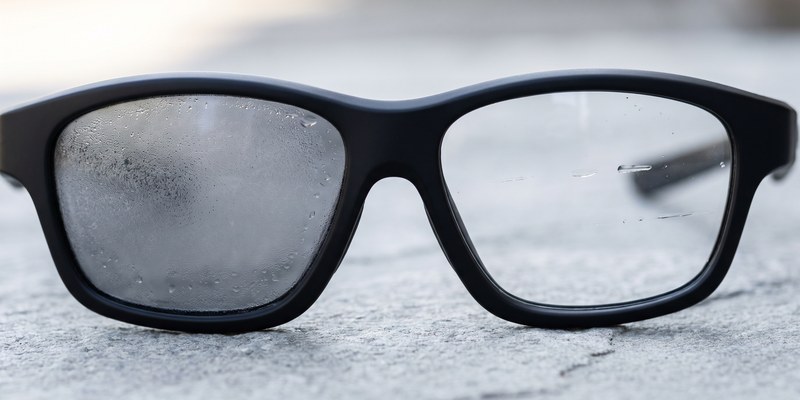
Fog is condensation. Warm, humid air from the face meets a lens surface that’s cooler than the dew point of that air, and water comes out of vapour onto the surface.
The critical detail is how it lands. Condensation forms as countless microscopic droplets, and each droplet refracts light in a slightly different direction. The surface isn’t wet so much as it is scattering — which is why fog obscures vision rather than simply blurring it.
That distinction points directly at the solution. You can fight fog by preventing condensation, or by changing the form it takes.
Hydrophilic vs Hydrophobic — Not the Same Thing
This is where specifications most often go wrong.
Hydrophilic anti-fog coatings are water-attracting. Instead of letting condensation bead into droplets, the surface causes water to spread into a continuous, uniformly thin transparent film. The water is still there — it simply no longer scatters light. This is what an anti-fog coating actually does, and it belongs on the inner lens surface.
Hydrophobic coatings are water-repelling. They cause water to bead and roll off, which is excellent for rain, sweat, and spray on the outer surface. On an inner surface, beading is precisely the behaviour you don’t want.
Brands regularly specify a hydrophobic treatment and expect fog performance from it. The two are near-opposites in mechanism, and a well-specified lens often carries both — hydrophobic outside, hydrophilic inside.
The Durability Problem Nobody Mentions
Here’s the issue that generates warranty complaints twelve months after launch: anti-fog coatings are consumable.
Hydrophilic layers degrade. They wash off with repeated cleaning, wear with wiping, and lose effectiveness with contamination from sweat, sunscreen, and oils. A product that performed perfectly in testing can fog freely after a season of use, and the customer reasonably concludes the anti-fog never worked.
Specification points that follow:
- Ask about expected service life, not just presence of a coating.
- Confirm cleaning compatibility. Some coatings are destroyed by alcohol-based cleaners — common in industrial settings.
- Distinguish permanent from semi-permanent systems. Bonded coatings generally outlast applied treatments.
- Provide care guidance in the packaging, since abrasive wiping shortens coating life considerably.
The Trade-Off at the Heart of It
Anti-fog and scratch resistance compete for the same surface, and this is where real engineering judgement enters.
Hard coatings deliver abrasion resistance. Hydrophilic anti-fog layers are typically softer and more vulnerable to wear. A lens surface can carry both, but doing so without one degrading the other is an achievement rather than a default — and it is exactly where cheap “anti-fog” products cut corners.
European eye protection marking makes this visible. Under EN 166, a product can carry K for resistance to surface damage by fine particles and N for resistance to fogging, with the fogging performance assessed by the EN 168 test method. A product carrying both has demonstrated it, rather than claimed it. For a safety eyewear line in particular, those markings are worth specifying deliberately as part of your certification planning.
What Coating Can’t Fix
Even an excellent coating is working against physics if the design loads it unfairly. Two structural approaches do more than any surface treatment:
Ventilation and standoff. Airflow between lens and face removes humid air before it condenses. This is a frame geometry decision — standoff distance, vent position at the top edge and lower corners, and a brow gap — and it has to be designed in before tooling. It’s the single biggest factor in whether a cycling or running frame fogs on a climb.
Dual-pane construction. In goggles, two lenses separated by a sealed air gap insulate the inner surface, keeping it closer to face temperature and further from the dew point. As covered in our snow eyewear guide, this is the most effective single anti-fog measure available — it attacks the temperature differential rather than managing the consequences.
The ordering matters: design first, coating second. A well-ventilated frame with a modest coating outperforms a sealed frame with an excellent one.
Testing Anti-Fog Performance
Anti-fog is measurable, and it should be measured rather than assumed. A meaningful programme covers:
- Initial fogging resistance, by a recognised method such as the EN 168 procedure
- Performance after cleaning cycles, which is where most coatings fail
- Performance after chemical exposure to sweat, sunscreen, and cleaning agents
- Performance at the temperature extremes the product is sold into
That second line is the one brands skip. A coating that passes fresh out of the mold and fails after twenty cleans has not solved the customer’s problem. Testing to a cleaning cycle count belongs in your quality control criteria alongside optical and impact checks, and an in-house testing laboratory makes that iteration practical rather than a six-week external queue.
Specifying Anti-Fog Properly
For a product brief, be explicit about:
- Hydrophilic inner treatment, hydrophobic outer treatment, or both
- Permanent bonded system or applied treatment
- Target service life and cleaning cycle count
- Whether K and N markings are required for your markets
- Ventilation and standoff targets in the frame design
- Dual-pane construction, for goggle products
- Care instructions supplied with the product
Where Tony Optical Fits
We manufacture sports and safety eyewear with lens production and coating in-house, which means anti-fog is applied and validated under the same roof as the rest of the product rather than subcontracted and assumed.
For brands where fogging is a known complaint, the useful conversation happens early — ventilation geometry before tooling, then a coating specification matched to the cleaning and chemical exposure the product will actually see. Testing to cleaning cycles rather than to first use is what separates a product that keeps working from one that passes a sample check.
Frequently Asked Questions
What’s the difference between hydrophilic and hydrophobic coatings?
Hydrophilic coatings spread condensation into a thin transparent film so it stops scattering light — this is anti-fog, applied to the inner surface. Hydrophobic coatings repel water into beads that roll off, used on the outer surface for rain and sweat.
Do anti-fog coatings wear off?
Yes. Hydrophilic layers degrade with cleaning, wiping, and contamination from sweat and sunscreen. Service life and cleaning compatibility should be specified, not assumed.
Why do my glasses still fog with anti-fog coating?
Usually because ventilation is inadequate. Coating manages condensation; airflow prevents it. A sealed or close-fitting frame overwhelms any coating.
What is the N marking on safety eyewear?
Under EN 166 it indicates resistance to fogging, assessed by the EN 168 test method. The K marking indicates resistance to surface damage by fine particles.
Can a lens be both anti-fog and scratch resistant?
Yes, but it’s a genuine engineering trade-off — hydrophilic anti-fog layers are softer than hard coatings. Products carrying both K and N markings have demonstrated the combination.
What’s the most effective anti-fog measure?
For goggles, dual-pane construction, because it reduces the temperature differential driving condensation. For spectacles, ventilation and standoff designed into the frame.
Final Thoughts
Anti-fog is treated as a coating line item and behaves as a system property. Brands that design ventilation first, specify the right coating chemistry for the right surface, and test against cleaning cycles rather than first use ship products that keep performing. Brands that add “anti-fog” to a spec sheet and move on ship products that fog in month four.
Developing eyewear where fogging matters? Get in touch with our team to discuss ventilation design, coating specification, and durability testing for your product.