0
0


- Home
- Blog
- Industry Insights
- Sunglasses Certification: Compliance Requirements by Market
Sunglasses Certification: Compliance Requirements by Market
Sunglasses Certification Explained: What Your Product Needs, Market by Market
Compliance is the least glamorous part of launching eyewear and the most expensive to get wrong. A frame that fails certification after mass production isn't a delay — it's inventory you can't legally sell.
The complication is that requirements differ by market, and by what your product claims to be. A lifestyle sunglass, a cycling shield, and a protective sports goggle can look similar and sit under entirely different standards. Here's how the landscape actually breaks down.
First: What Kind of Product Are You Making?
Before looking at any specific standard, answer this — it determines everything downstream.
General-use sunglasses are worn for comfort and sun protection. They fall under sunglass standards focused on UV protection, optical quality, and lens category.
Protective sports eyewear claims to protect the eye from impact or hazard. That claim pulls the product into a stricter category with mechanical strength requirements, and it's a claim you make through your marketing as much as your design. Describing a frame as "impact protection" or "safety" has regulatory consequences.
Get this classification wrong and you can test to the wrong standard entirely — passing a test that doesn't apply to what you're actually selling.
European Union
The EU treats sunglasses as personal protective equipment, which means CE marking is mandatory. The relevant standards:
- EN ISO 12312-1 — sunglasses for general use. Covers UV protection, lens category and transmittance, optical quality, and frame requirements.
- EN ISO 12312-2 — filters for direct observation of the sun (a specialist category).
- ISO 16321-1 — eye and face protectors for occupational and sports use. This is the standard that applies when you make a protection claim, and it replaced the older EN 166 framework for these products.
Practical points: CE marking requires proper technical documentation and a Declaration of Conformity, not just a test report. The UK now requires UKCA marking separately from CE. And REACH restricts specific chemical substances — relevant for UV absorbers, colorants, and plasticizers in both frames and lenses, and something we've had to navigate directly in material formulation for EU-bound products.
United States
The US path is different in structure. Non-prescription sunglasses are regulated by the FDA as Class I medical devices, which carries two main implications:
- Impact resistance is mandatory. FDA requires lenses to meet an impact-resistance requirement — this isn't optional or market-driven, it's federal law.
- Establishment registration and device listing requirements apply to manufacturers.
Alongside that, ANSI Z80.3 is the industry standard for non-prescription sunglasses, covering transmittance, UV protection, and optical quality. For protective sports eyewear, ANSI/ISEA Z87.1 is the occupational and safety eyewear standard, and specific sports may have their own governing-body requirements.
One US-specific trap: California Proposition 65 requires warnings for listed substances and applies regardless of federal compliance. Brands routinely discover this after their first California order.
Other Major Markets
- Australia and New Zealand — AS/NZS 1067 governs sunglasses, with its own lens category system and mandatory labeling.
- Canada — largely aligns with US requirements, with its own labeling expectations.
- Japan and South Korea — have national standards; verify current requirements before committing to a launch.
If you're selling into multiple regions, the practical approach is to design to the strictest applicable standard rather than certifying separately for each — usually cheaper and simpler than managing divergent SKUs.
What Actually Gets Tested
Across most standards, the same core properties are evaluated:
- UV transmittance — verifying the UV protection claim
- Luminous transmittance and lens category — the VLT classification determining what conditions the lens suits
- Optical quality — refractive power, prism, and distortion
- Impact resistance — mandatory in the US, and central to protective standards
- Traffic signal recognition — whether the tint distorts signal colors, a common failure point for heavily tinted or unusual color filters
- Frame requirements — including frame transmittance, mechanical strength, and material safety
That traffic-signal test catches more products than brands expect. Aggressive contrast tints and fashion-driven colors can fail it while performing beautifully in every other respect.
Where Brands Get Caught Out
From our experience running in-house testing, the recurring failures are predictable:
- Testing too late. Certification after mass production means unsellable stock. Test the approved sample, before the run.
- Making protection claims without protective certification. Marketing copy that says "impact protection" changes which standard applies.
- Category 4 lenses sold for driving. Category 4 is not permitted for driving in most markets and requires explicit marking.
- Overlooking chemical compliance. REACH and Prop 65 are separate from optical performance and easy to forget until a shipment is held.
- Assuming a component certificate covers the product. A certified lens in an untested frame is not a certified product — the assembled article is what gets certified.
Building Compliance Into Development
The efficient approach is to treat compliance as a design input rather than a final gate. That means confirming target markets before design begins, since requirements shape material and lens choices; verifying lens category and tint against the traffic-signal requirement early; checking material formulations for restricted substances before tooling; and testing the golden sample before mass production, as we outline in our development timeline guide.
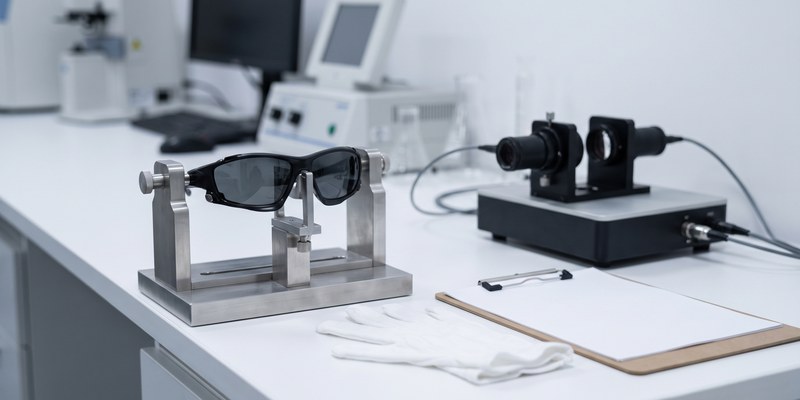
A manufacturer with an in-house lab can iterate quickly here — testing, adjusting, and retesting in days rather than waiting weeks on external queues.
Where Tony Optical Fits
We manufacture sports eyewear for brands selling across the EU, US, and Asia-Pacific, with in-house production and our own testing laboratory. That means we can advise on which standards apply to your specific product and claims, verify performance before mass production, and provide the certification documentation your markets require.
We've also worked through the harder cases — including reformulating UV absorber packages to meet both frame transmittance requirements and REACH restrictions simultaneously.
Frequently Asked Questions
Do all sunglasses need CE marking to sell in the EU?
Yes. Sunglasses are classified as personal protective equipment in the EU, so CE marking with supporting technical documentation and a Declaration of Conformity is required.
Is ANSI Z80.3 mandatory in the United States?
ANSI Z80.3 is a voluntary industry standard, but FDA impact-resistance requirements are mandatory federal law for non-prescription sunglasses. Most buyers and retailers expect Z80.3 compliance regardless.
What's the difference between EN ISO 12312-1 and ISO 16321?
EN ISO 12312-1 covers general-use sunglasses. ISO 16321 covers eye protectors for occupational and sports use, and applies when your product makes a protective claim.
Who is responsible for certification — the brand or the manufacturer?
Legal responsibility for a product placed on the market generally sits with the brand or importer, but a capable manufacturer provides the testing, documentation, and technical file to support it. Clarify this split in writing before production.
When should certification testing happen?
On the approved golden sample, before mass production. Testing after a production run risks an entire batch.
Does a certified lens mean a certified product?
No. Certification applies to the finished assembled product. A compliant lens in an untested frame does not satisfy the requirement.
Final Thoughts
Compliance rewards planning and punishes improvisation. Brands that define their markets early, classify their product honestly, and test before production treat certification as a routine checkpoint. Brands that leave it to the end discover how expensive a failed test can be.
Planning a launch across multiple markets? Get in touch with our team to discuss which standards apply to your product and how we can support certification from development through production.