0
0


- Home
- Blog
- Lens Technology
- Ski & Snow Eyewear: Lens Category, VLT & Spec Guide
Ski & Snow Eyewear: Lens Category, VLT & Spec Guide
Ski and Snow Eyewear: Specifying Lens Category, Coverage, and Anti-Fog Performance
Snow environments are optically extreme. Fresh snow reflects the large majority of incident light, and UV intensity climbs measurably with altitude. An athlete on a glacier is receiving light from above and from below, at intensities no other common sport approaches.
That combination drives specifications unlike anything in cycling or fishing. Here's what snow eyewear actually requires.
Lens Category Is the Central Decision
In most sports, lens category is a comfort preference. In snow it's a protection requirement.
- Category 3 covers most resort skiing in bright conditions — the standard choice for general alpine use.
- Category 4 is specified for glacier travel, high-altitude mountaineering, and extreme sustained glare, transmitting very little light.
- Category 1 and 2 matter more than brands expect, for flat light, overcast days, storm skiing, and night operations.
The Category 4 caveat that catches brands out: Category 4 lenses are not permitted for driving in most markets and require explicit marking to that effect. If your range includes a glacier or mountaineering model, that marking obligation is not optional — and as covered in our certification guide, getting lens category marking wrong is one of the more common compliance failures.
Because conditions on a mountain change faster than any other environment in this series, snow is the strongest case for photochromic lenses and for interchangeable-lens systems. Many serious products offer both a bright-light and a flat-light lens in the box.
Flat Light: The Problem Tint Actually Solves
Bright-sun glare is the obvious challenge. Flat light is the harder one.
In overcast or falling snow, contrast collapses. The surface loses definition, and a skier genuinely cannot see moguls, ruts, or terrain changes — a safety issue as much as a performance one.
This is where contrast-enhancing tints earn their place. Rose, amber, and vermilion tints selectively filter to restore definition against white terrain. For a snow product, offering a flat-light lens option isn't a premium upsell; it's what makes the product usable across a real season. Our guide to contrast-enhancing lens technology covers the mechanisms involved.
On polarization: it's a genuine split in this category. Polarization cuts glare off snow effectively, but many skiers and mountaineers deliberately avoid it because reflections help reveal ice patches. For a technical alpine product, non-polarized is often the deliberate choice.
Goggle or Sunglass?
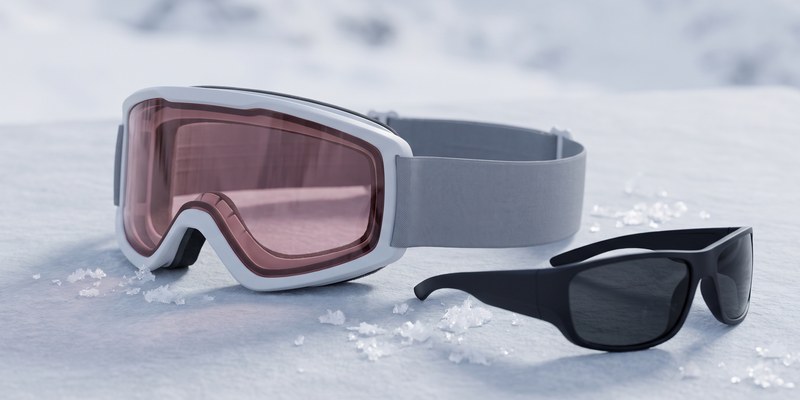
Snow is the one discipline where both form factors coexist in the same product line, and they solve different problems.
Goggles seal against the face, delivering full peripheral coverage, wind and snow exclusion, and helmet integration. They're the default for downhill and freeride.
Sunglasses are preferred for ski touring, cross-country, and mountaineering ascents — activities generating high heat and sweat, where a sealed goggle fogs badly and ventilation matters more than sealing.
Many alpine athletes carry both: sunglasses on the climb, goggles on the descent. If you're building a mountain range, consider whether you're serving one use case or both, because the design requirements diverge sharply.
Anti-Fog: Harder Here Than Anywhere
Fogging in snow sport combines every contributing factor — a large temperature differential between inside and outside the lens, high exertion, and a sealed or close-fitting design.
The engineering responses:
- Dual-pane lens construction in goggles, where an air gap between two lenses reduces the thermal gradient at the inner surface — the single most effective measure available
- Ventilation channels positioned to move air without admitting snow
- Hydrophilic anti-fog coating on the inner surface
- Frame standoff in sunglass designs to maintain airflow
As with cycling eyewear, this is primarily a design and geometry problem. Coating supplements ventilation; it never replaces it.
Cold-Weather Material Behavior
Sub-zero temperatures change how materials behave, and specifications that work in temperate conditions can fail on a mountain.
- Low-temperature flexibility is essential. Materials that stiffen or turn brittle in cold risk cracking on impact — a real concern in a sport where falls are routine.
- Dimensional stability across a wide range matters, since eyewear moves between a warm lodge and an exposed ridge repeatedly. Nylon (PA12) performs strongly here, which is why it appears in technical alpine products. Our material comparison covers the alternatives.
- Face foam in goggles must stay pliable when cold and manage moisture without freezing.
- Impact performance at low temperature should be verified at temperature, not just at ambient — a distinction worth confirming in your testing programme.
Helmet Integration and Retention
Snow eyewear must work with a helmet, and the fit details matter:
- Goggle frame profile must mate cleanly with the helmet's front edge — the notorious "gaper gap" is a fit failure buyers notice immediately
- Strap width, elasticity, and silicone grip determine retention over a full day
- Clip compatibility for helmet strap attachment on technical models
- Sunglass temple profile must run cleanly under a helmet without pressure points
Specification Checklist
For a snow eyewear line, define:
- Target use — resort, touring, freeride, or mountaineering
- Lens categories offered, and flat-light option
- Category 4 marking requirements, if applicable
- Photochromic or interchangeable system
- Polarization decision
- Goggle, sunglass, or both
- Dual-pane construction and ventilation design
- Anti-fog coating specification
- Cold-temperature material and impact validation
- Helmet compatibility
Where Tony Optical Fits
We manufacture sports eyewear for alpine and cold-weather applications, with in-house production, lens and coating capability, and environmental testing that validates performance at temperature rather than only on the bench.
For snow products specifically, we can advise on lens category strategy across a range, the marking requirements Category 4 carries, and the ventilation design that determines whether a product fogs in real use.
Frequently Asked Questions
What lens category is best for skiing?
Category 3 for most bright resort conditions, Category 4 for glacier and high-altitude use, Category 1 or 2 for flat light and storm skiing. A range should cover more than one.
Can Category 4 lenses be used for driving?
No. Category 4 is not permitted for driving in most markets and must be marked accordingly.
Should ski eyewear be polarized?
It's a genuine split. Polarization cuts snow glare, but many skiers avoid it because reflections help identify ice. Technical alpine products are often deliberately non-polarized.
Why do ski goggles use two lenses?
Dual-pane construction creates an insulating air gap that reduces the temperature differential at the inner lens surface — the most effective anti-fog measure available.
Goggles or sunglasses for ski touring?
Sunglasses generally suit the ascent, where exertion and heat cause goggles to fog. Many tourers carry both and switch for the descent.
What tint works in flat light?
Rose, amber, and vermilion contrast tints restore definition when overcast conditions flatten the terrain.
Final Thoughts
Snow is the most demanding optical environment in sport, and the one where a poorly specified product is most obviously inadequate. Brands that plan a lens category strategy across conditions, engineer ventilation properly, and validate materials at temperature build equipment that performs. Brands that ship a single dark lens discover its limits on the first overcast day.
Developing a snow eyewear line? Get in touch with our team to discuss lens category strategy, anti-fog design, and cold-weather validation.