0
0


- Home
- Blog
- Frame & Materials
- Frame Geometry: Sizing, Base Curve & Fit for Sports Eyewear
Frame Geometry: Sizing, Base Curve & Fit for Sports Eyewear
Understanding Frame Geometry: Sizing, Base Curve, and Fit in Sports Eyewear
Two frames can share the same material, the same lens spec, and the same styling — and one will sell while the other generates returns. The difference is usually geometry.
Fit is the least discussed and most consequential part of an eyewear specification. It determines whether a frame stays put during a sprint, whether it fogs, whether it pinches after two hours, and whether it fits the faces in your target market at all. Here's what the numbers mean and how to specify them deliberately.
The Core Measurements
Eyewear sizing follows a convention you've seen printed inside temples — something like 56□17-125. Three numbers, in millimeters:
- Lens width (eye size) — the horizontal width of one lens at its widest point
- Bridge width (DBL) — the distance between lenses
- Temple length — the arm, measured from hinge to tip
Together these govern how the frame sits horizontally. But for sports frames, several measurements outside that convention matter just as much:
- Lens height — critical for coverage; too short and you get light leak from above or below during head-down positions
- Total frame width — hinge to hinge, determining how the frame sits across the face
- Temple tip drop — how much the arm curves down behind the ear, driving retention
A Practical Warning About Measurement Conventions
Here's something that causes more confusion in sourcing than it should: suppliers don't all measure the same way.
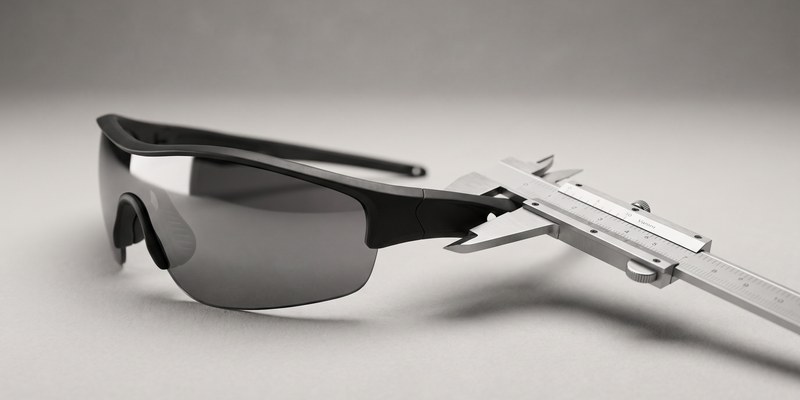
Temple length is the usual culprit. Some measure along the straight portion only; others measure the full length including the bend. A frame described as 129mm by one factory and 125mm by another can be the identical part measured under different conventions. The same ambiguity affects lens height and total width.
If you're comparing quotes across suppliers, or transferring a design from one manufacturer to another, confirm the measurement convention explicitly — ideally with a dimensioned drawing rather than a spec table. It's a small clarification that prevents a genuinely expensive misunderstanding at the tooling stage.
Base Curve: The Measurement That Defines Sports Eyewear
If one number separates sports frames from lifestyle frames, it's base curve — the curvature of the lens, expressed in "base" units. Higher numbers mean more curvature.
- 4 to 6 base — flatter lenses, typical of lifestyle and fashion frames
- 6 base — the general-purpose middle ground
- 8 base and above — the wrap curvature that defines performance sports eyewear
Why sports frames wrap: higher base curve follows the contour of the face, which delivers peripheral coverage, blocks light and wind entering from the sides, improves retention during movement, and reduces debris ingress. For cycling, running, and watersports, that wrap is a functional requirement, not a style choice.
What wrap costs you: curvature introduces optical challenges. As a lens wraps away from the line of sight, it can induce prismatic distortion — objects appearing subtly displaced, particularly at the periphery. Correcting this requires proper lens decentration and optical compensation during design. It's precisely why a poorly executed 8-base frame can cause eye strain or nausea while a well-engineered one feels effortless.
This also matters if you plan to offer prescription compatibility. High-base-curve wrap frames are considerably more difficult to fit with prescription lenses, which is why many brands offer an RX insert system instead of direct glazing.
Angles: Pantoscopic Tilt and Face Form
Two rotational angles complete the geometry picture:
Pantoscopic tilt is the vertical angle of the lens relative to the face — the degree to which the bottom of the lens sits closer to the cheek than the top. Appropriate tilt improves the field of view for downward gaze, which matters enormously for cyclists in a drop position or runners watching trail.
Face form (wrap angle) is the horizontal angle at which the lenses sweep back toward the temples. It works with base curve to determine coverage and, critically, the gap between frame and face — which governs airflow.
That airflow point deserves emphasis. Fogging is one of the most common complaints in sports eyewear, and it's a geometry problem before it's a coating problem. Frames that sit too close to the face restrict ventilation. Getting the standoff distance and vent placement right in the 3D design stage prevents a problem that no anti-fog treatment fully solves afterward.
Designing for Your Target Market
Facial morphology varies meaningfully across populations, and a frame engineered for one market can fit poorly in another. The most common issue is bridge geometry: a nose bridge designed around a higher nasal bridge tends to slide down on lower-bridge faces, while sitting too high and restricting airflow.
This is why Asian fit (or alternative fit) versions exist — typically featuring adjusted nose pad geometry or increased pad height, modified pantoscopic tilt, and sometimes a wider bridge.
If you're selling globally, decide early whether you need a single universal geometry or market-specific variants. Adjustable nose pads offer a middle path — one mold, adaptable fit — at some added component cost. This decision belongs in the brief, not after tooling, since bridge geometry is molded into the frame front.
Specifying Geometry for Your Line
Practical guidance when developing a frame:
- Start from the sport. Cycling, fishing, and racquet sports have different coverage, ventilation, and retention priorities.
- Match base curve to purpose. 8-base for genuine wrap performance; 6-base where a sport-lifestyle crossover is the target.
- Specify retention features deliberately — rubber nose pads and temple tips, adjustable components, or a strap-compatible design.
- Plan ventilation in CAD, not as an afterthought.
- Consider material and geometry together. A demanding wrap geometry needs a material with the dimensional stability to hold it — one reason nylon frames suit aggressive shield designs.
- Prototype and test on real faces. No dimension table substitutes for a physical sample on the heads of your actual customers.
Where Tony Optical Fits
Frame geometry is where manufacturing experience shows most clearly. We work with brands on sports eyewear geometry from the brief onward — advising on base curve, coverage, ventilation, and fit variants, then engineering the design so it molds cleanly and holds its shape in production.
With in-house injection molding, lens production, and our own testing lab, we can validate that a wrap geometry delivers the optical performance it needs — not just the look.
Frequently Asked Questions
What base curve should sports sunglasses use?
8-base is standard for performance wrap frames, delivering peripheral coverage and retention. 6-base suits sport-lifestyle crossover styles where full wrap isn't required.
Why do wrap-around sunglasses sometimes cause eye strain?
High base curve can induce prismatic distortion if the lens isn't properly decentered and optically compensated. A well-engineered wrap lens corrects for this; a poorly executed one doesn't.
What do the numbers printed on sunglasses temples mean?
They're lens width, bridge width, and temple length in millimeters — for example 56□17-125.
Can prescription lenses be fitted into wrap sports frames?
It's possible but technically demanding at high base curves. Many brands offer an RX insert system rather than direct glazing.
What is Asian fit eyewear?
Frames with adjusted bridge and nose pad geometry, and often modified tilt, designed for lower nasal bridge profiles — improving both stability and airflow.
How do I stop sports sunglasses from fogging?
Fogging is primarily a ventilation and geometry issue. Adequate standoff distance and vent placement designed into the frame matter more than anti-fog coating alone.
Final Thoughts
Material and lens technology get the marketing attention, but geometry is what customers actually feel. A frame that fits disappears on the face; one that doesn't gets returned regardless of how good its specification looks on paper. Specifying geometry deliberately — for the sport, for the market, and for real faces — is among the highest-leverage decisions in eyewear development.
Developing a new sports frame? Get in touch with our team to discuss geometry, fit, and base curve for your target sport and markets.