0
0


- Home
- Blog
- Lens Technology
- Running Sunglasses: Weight, Bounce & Lens Specification Guide
Running Sunglasses: Weight, Bounce & Lens Specification Guide
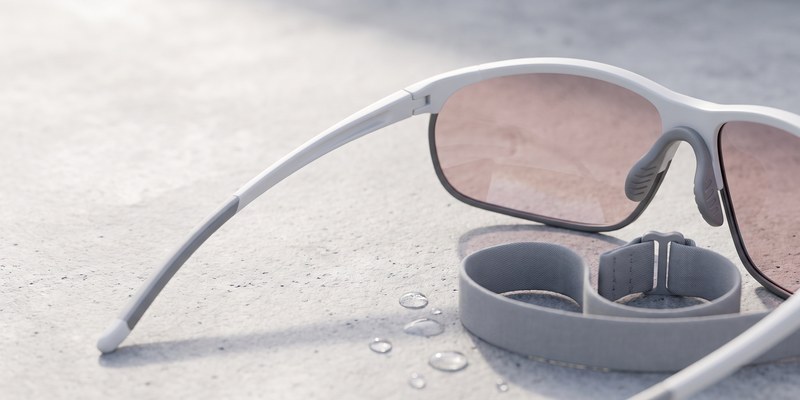
Running Eyewear: Specifying Weight, Fit, and Lenses for Road and Trail
A cyclist's glasses sit still relative to their head. A runner's don't. Every stride sends an impact up through the body, thousands of times per hour, and any frame that isn't designed for it slides, bounces, and gets taken off by the second kilometer.
That makes running the sport where eyewear succeeds or fails on fit and weight rather than lens technology. Here's how to specify for it.
Weight Is the First Specification
In most sports, weight is a comfort consideration. In running it's a functional one.
Bounce is a function of mass. A heavier frame carries more momentum with each footstrike, which means more force working against the nose pads and temples on every stride. Reduce the mass and you reduce the problem at its source — before any grip material has to do any work.
This makes material selection central. TR90 is the mainstream choice for running frames: very light, flexible, and comfortable over long distances. Nylon (PA12) suits premium performance models where stability and durability justify the cost. Our material comparison covers the trade-offs in full.
Construction choices matter as much as material:
- Half-rim and rimless designs remove material from the frame front
- Thin temple profiles reduce mass at the sides
- Polycarbonate lenses keep lens weight to a minimum
- Minimal hardware — fewer metal components means less mass and fewer failure points
Weight distribution matters too. A frame that's front-heavy tips forward and slides down the nose even at modest total weight. Balance between front and temples is part of the design, not an accident.
Stopping Bounce: Retention Design
Once weight is minimized, retention does the rest.
Hydrophilic rubber on nose pads and temple tips is the standard solution — a material that grips harder as it gets wet, so retention improves as the runner sweats. For running this is effectively a requirement rather than an upgrade.
Temple geometry carries more of the load than brands expect. A slight inward wrap that grips the side of the head, combined with a moderate temple tip drop behind the ear, holds the frame without pressure points. Too much grip creates headaches over a long run; too little and the frame bounces. Getting that balance right is part of frame geometry engineering, and it's worth testing on real runners rather than on a fixture.
Adjustable nose pads let one frame fit a wider range of faces — useful because a nose bridge that sits even slightly wrong is the most common cause of bounce.
Sweat Management
Runners sweat heavily, and sweat affects eyewear in three ways:
- Drips onto the lens, obscuring vision mid-run
- Loosens grip, unless retention materials are hydrophilic
- Fogs the lens when the runner slows or stops
Design responses include a frame brow that channels sweat away from the lens, hydrophobic and oleophobic lens coatings that shed droplets rather than smearing, and lens venting or frame standoff to maintain airflow. As with cycling eyewear, fogging is primarily a ventilation problem — coating supplements airflow but can't replace it.
Lens Selection: Road vs Trail
Road running typically suits Category 2 or 3 lenses in neutral or light contrast tints. Many road runners train early morning or evening, when a Category 3 lens is too dark — which makes photochromic an attractive option for runners who head out in low light and finish in full sun.
Trail running has the same challenge that mountain biking does: constant transitions between tree cover and open sky. Photochromic handles that well, and contrast-enhancing tints in amber or rose help define roots, rocks, and uneven ground. As covered in our guide to choosing lenses by sport, trail runners often prefer non-polarized lenses, since reflections from wet surfaces help them read footing.
On polarization for running generally: it's rarely essential. Polarization can interfere with reading a GPS watch at certain angles, and running rarely involves the flat reflective surfaces where polarization shines. It's a reasonable option for coastal and beach running, but shouldn't be a default.
Race-day lenses are worth considering as a distinct product. Many runners want a lighter tint for race conditions they can't predict, or a clear lens for very early starts.
Fit and Compatibility
A few running-specific fit details:
- Cap and visor compatibility — temples must sit cleanly under a cap brim and over or under a band, without pressure points
- Smaller face fits — running has a broad participant base, and a single universal size doesn't fit everyone well; a smaller-fit version often sells meaningfully
- Headphone compatibility — temples shouldn't clash with earbuds or bone-conduction headphones worn over the ear
- Field of view — runners look slightly downward at the ground ahead, so lens depth and pantoscopic tilt should support that gaze
Specification Checklist
For a running line, define:
- Target frame weight and material
- Half-rim, rimless, or full-rim construction
- Front-to-temple weight balance
- Hydrophilic nose pad and temple tip specification
- Adjustable nose pad option
- Sweat channel and lens coating approach
- Lens category range, and photochromic option
- Polarization decision
- Standard and smaller fit sizes
- Cap and headphone compatibility
Where Tony Optical Fits
We manufacture lightweight sports eyewear for running and endurance applications, with in-house injection molding across TR90 and nylon, lens production, and our own testing lab. That means we can advise on weight targets, retention design, and lens specification together — the three decisions that determine whether a running frame stays on the face.
Frequently Asked Questions
How do I stop running sunglasses from bouncing?
Start with a lighter frame, since bounce is driven by mass. Then add hydrophilic rubber nose pads and temple tips, and a temple geometry that grips the side of the head without pressure.
Should running sunglasses be polarized?
Usually not necessary. Polarization can interfere with reading a GPS watch, and running rarely involves the reflective surfaces where it helps most. Coastal and beach running are the exceptions.
What lens is best for running?
Category 2 or 3 in a neutral or light contrast tint for road running. Photochromic for runners who start in low light, and amber or rose contrast tints for trail running.
What frame material is best for running sunglasses?
TR90 for most running frames, thanks to its light weight and flexibility. Nylon (PA12) for premium models where stability and durability matter.
Why do running sunglasses fog?
Mainly when the runner slows or stops and airflow drops. Frame standoff and lens venting help most; anti-fog coating is a useful supplement.
Do running sunglasses need a smaller size?
Often yes. A standard fit doesn't suit every face, and a smaller-fit version reduces bounce and slippage for runners with narrower faces.
Final Thoughts
Running eyewear is judged in the first few minutes of a run. A frame that's light, balanced, and grips properly disappears; one that bounces gets pushed up the nose a hundred times and eventually left at home. Brands that specify weight and retention first, then lenses, build running products that actually get worn.
Developing a running eyewear line? Get in touch with our team to discuss weight targets, retention design, and lens options for road and trail.