0
0


- Home
- Blog
- Lens Technology
- Cycling Sunglasses: Lens, Fit & Coverage Specification Guide
Cycling Sunglasses: Lens, Fit & Coverage Specification Guide
Cycling Eyewear: How to Specify Lenses, Fit, and Coverage for Road and Trail
Cycling is one of the most demanding applications in sports eyewear, and one of the easiest to get wrong. The rider's head position, speed, and exposure combine into requirements that don't apply to most other sports — which is why a general-purpose sunglass rarely performs well on a bike.
Here's what actually matters when specifying cycling eyewear, and where road and mountain requirements diverge.
Start With Head Position
Everything about cycling eyewear follows from one fact: cyclists look up through the top of the lens.
A rider in a road position — torso low, head tilted forward — is looking through the upper portion of the frame at the road ahead. On a lifestyle sunglass, that's where the frame rim sits, which puts a bar across the rider's field of view exactly where they need to see.
This drives three specifications:
- Tall lens height for adequate upper coverage
- Rimless or half-rim upper construction to remove the obstruction entirely
- Pantoscopic tilt angled for a forward-leaning head position rather than an upright one
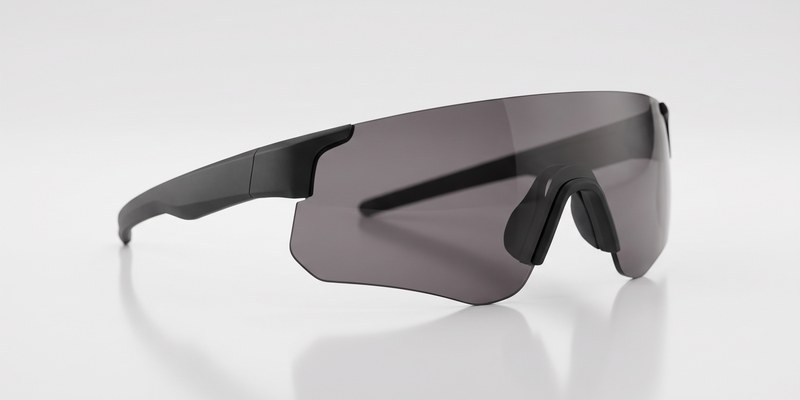
It's also why so many cycling frames use the distinctive shield or oversized single-lens shapes — coverage upward and outward, without a rim in the sightline. Achieving those shapes reliably depends on the base curve and frame geometry being engineered properly, since a large single-lens front is unforgiving of dimensional drift.
Lens Selection: Road vs Trail
Cycling lens requirements split meaningfully by discipline.
Road cycling typically favors photochromic lenses. Rides often start at dawn and run into full midday sun, and a rider isn't stopping to swap lenses. As covered in our guide to choosing lenses by sport, photochromic handles that range in a single lens.
A road-specific caution on polarization: many riders use head units and cycling computers, and polarized lenses can black out LCD displays at certain angles. If your target customer rides with a computer, polarization is a liability rather than a feature.
Mountain biking has different priorities. Riders move between dense tree cover and open sun repeatedly, so photochromic works well here too — but trail riders often prefer non-polarized lenses deliberately. Reflections off wet rock, roots, and loose surfaces carry information a rider uses to read terrain. Removing that glare removes the cue.
MTB also favors contrast-enhancing tints in amber, rose, or copper, which sharpen the definition of trail features against surrounding ground.
Category selection matters across both: Category 3 for bright open conditions, Category 2 for variable, Category 1 or clear for dawn, dusk, and heavy forest. Many brands address this with interchangeable-lens systems rather than forcing one compromise.
Fogging Is a Design Problem
Fogging is the single most common complaint in cycling eyewear, and it's worth being direct about why: it's primarily a ventilation and geometry issue, not a coating issue.
A rider climbing slowly generates significant heat and moisture while airflow drops to almost nothing. If the frame sits too close to the face, warm humid air has nowhere to go.
Design responses that actually work:
- Adequate standoff distance between lens and face
- Vent placement at the top edge and lower corners of the lens
- Brow gap allowing air to pass between frame and helmet
- Hydrophilic anti-fog treatment as a supplement — not a substitute for airflow
Specify ventilation in CAD at the 3D design stage. It cannot be fixed after tooling.
Retention and Helmet Compatibility
Two practical requirements that separate cycling frames from general sports frames:
Retention under vibration. Road buzz and trail chatter work eyewear loose. Hydrophilic rubber nose pads and temple tips — the kind that grip more as they get wet with sweat — are standard for good reason. Adjustable nose pads help accommodate different face shapes without new tooling.
Helmet integration. Cycling eyewear must work with a helmet, which constrains temple design at the point where the arm passes the helmet retention strap and the helmet's front edge. Straight or minimally curved temples that slide cleanly under helmet straps are preferred. Many riders also stow their glasses in helmet vents, so temple tip geometry matters more than it might seem.
Impact and Compliance
Cycling eyewear commonly encounters debris — grit, insects, stone chips at speed. Impact resistance is a genuine functional requirement, not a marketing line.
Be deliberate about what you claim. As covered in our certification guide, describing a product as protective eyewear pulls it under stricter standards. Decide early whether you're making a protection claim, because it changes which standard applies and what testing you need before production.
Material Considerations
Cycling frames combine large surface areas, thin sections for weight, and demanding wrap geometry — a combination that punishes weak materials.
TR90 suits the mainstream of cycling eyewear: light, flexible, and cost-effective. Nylon (PA12) is the choice for premium and flagship models, where its dimensional stability holds an aggressive shield geometry and resists the fatigue of repeated flexing. Our material comparison guide covers the full trade-offs.
Lens material for cycling is almost universally polycarbonate, chosen for impact resistance and low weight.
Specification Checklist
For a cycling line, define these before development:
- Road, mountain, or both — they're different products
- Lens height and upper coverage for riding position
- Rimless, half-rim, or full-rim construction
- Photochromic, fixed tint, or interchangeable system
- Polarization decision (and head unit compatibility)
- Ventilation and standoff geometry
- Helmet-compatible temple profile
- Retention components
- Whether you're making a protective claim
Where Tony Optical Fits
We manufacture sports eyewear for cycling and other performance disciplines, with in-house injection molding, lens production, and our own testing lab. That means we can advise on the geometry and lens specification a cycling frame actually needs — and validate impact and optical performance before mass production.
Frequently Asked Questions
Should cycling sunglasses be polarized?
Often not. Polarized lenses can black out cycling computer displays, and mountain bikers frequently prefer non-polarized to read reflections off wet trail surfaces. Polarization suits some riders but shouldn't be a default.
What lens tint is best for cycling?
Photochromic for variable light on road and trail. Amber, rose, or copper contrast tints suit mountain biking. Category 3 for bright conditions, Category 1 or clear for low light.
Why do cycling glasses fog up?
Primarily inadequate ventilation and insufficient standoff between lens and face, especially during slow climbs. Anti-fog coating helps but cannot compensate for poor airflow design.
Why do cycling sunglasses have such large lenses?
Because riders look up through the upper part of the lens in a forward-leaning position. Tall lenses and rimless upper edges keep the sightline clear.
What frame material is best for cycling eyewear?
TR90 for mainstream lines, nylon (PA12) for premium models needing dimensional stability in aggressive wrap geometries.
Do cycling sunglasses need impact certification?
Only if you make a protective claim — but that claim changes which standards apply. Decide before development, not after.
Final Thoughts
Cycling eyewear rewards specificity. A frame designed around a rider's actual head position, ventilation needs, and helmet interface performs in ways a repurposed lifestyle sunglass never will. Brands that specify for the discipline build products riders keep buying.
Developing a cycling eyewear line? Get in touch with our team to discuss lens, geometry, and coverage specification for road or trail.