0
0


- Home
- Blog
- Manufacturing Insights
- Eyewear Product Development: From 3D Design to Production
Eyewear Product Development: From 3D Design to Production
From 3D Design to Mass Production: The Eyewear OEM Development Timeline
Most brands understand what happens on a production line. Far fewer understand what happens before it — the stretch between "here's our concept" and "this sample is approved for mass production."
That stretch is where projects gain or lose months, where budgets get blown, and where the difference between an experienced manufacturer and an order-taker becomes obvious. Here's what actually happens at each stage, and where brands most often get stuck.
Stage 1: Design Brief and Feasibility Review
Development starts before anyone opens a CAD file. A good manufacturer will want to understand the sport or use case, the target price point, the intended frame material, lens requirements, target markets, and expected volumes.
Then comes the step brands most often skip: a feasibility review. Not every beautiful sketch can be injection-molded. Undercuts that trap a part in the mold, wall thicknesses that warp during cooling, hinge geometries that won't survive real use — these are cheap to fix on a screen and expensive to fix in steel.
Raising these issues early isn't a manufacturer being difficult. It's the single highest-value thing a factory does for you, and it's why involving one before your design is finalized saves more time than any other decision in this process.
Stage 2: 3D Design and Engineering
Once the concept is agreed, it's translated into a full 3D CAD model — the master file everything downstream depends on.
This is engineering, not styling. The model has to account for wall thickness and material flow during injection molding, draft angles so the part releases cleanly, hinge and temple mechanics, lens groove geometry and the curvature the lens will be cut to, fit and ergonomics across face shapes, and how components assemble.
An important distinction worth asking about: does your manufacturer work by reverse-engineering an existing frame you provide, or by forward-designing from your brief? Reverse engineering is faster and cheaper, but it constrains you to what already exists. Forward design costs more up front and delivers something genuinely your own. Both are legitimate — but know which one you're buying.
Stage 3: Prototyping
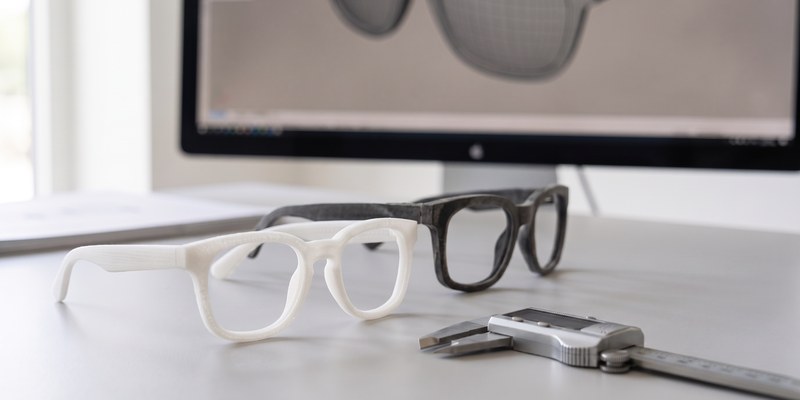
Before committing to tooling, the design becomes something physical. This typically happens in two quick passes: a 2D and handmade prototype (around 1 week) to check basic proportion and concept, followed by a 3D and rapid prototype (around 1 week) via 3D printing or CNC machining for a far more accurate physical model.
The purpose is to catch what a screen can't show you. A frame can look perfect in a render and feel wrong on a face: temple pressure in the wrong place, a nose bridge that sits too low, proportions that read differently in the hand. Prototypes let you check fit, ergonomics, proportion, and component clearance while changes still cost almost nothing.
This is the cheapest stage at which to change your mind. Two weeks of prototyping can save you a 45-to-60-day tooling cycle — the single best return on time in the entire development process. Brands that iterate hard here ship better products; brands that rush past it pay for it in Stage 4.
Stage 4: Tooling — Where Time and Money Concentrate
Tooling means cutting your design into hardened steel molds. It is the longest, most expensive, and least reversible step in the entire process — typically 45 to 60 days. Everything before it takes weeks; this stage takes months, which is exactly why the earlier stages deserve your full attention.
Each frame typically requires multiple molds — front, temples, and any separate components — each precision-machined and then polished, textured, and trial-fitted. Multi-component or interchangeable-lens designs need more tooling than simple single-piece frames, which is why frame complexity drives cost so heavily.
Two things worth understanding before you commit:
- Modifications are constrained. Adding material to a mold is difficult; removing it is easier. Significant design changes after tooling may mean cutting new steel entirely.
- Ownership matters. Clarify who owns the molds, where they're stored, and what happens if you change manufacturers. Get it in writing before tooling starts, not after.
Stage 5: T1 Samples and Iteration
The first parts off a new mold — often called T1 samples — are where design meets reality. Plan for 15 to 20 days for sampling.
Expect adjustments. Molds get tuned: gate positions refined, cooling adjusted, textures corrected, fit dialed in. A second or third round of samples is normal and healthy, not a sign something went wrong. Manufacturers who promise perfect first-shot results are either overselling or planning to ship you something under-refined.
At each round you're evaluating dimensional accuracy against spec, surface finish and color match, hinge function and durability, lens fit and optical alignment, and overall comfort.
Stage 6: Testing and Certification
Once a sample is functionally approved, it goes to validation. Sports eyewear typically needs impact resistance testing, UV transmittance and optical verification, abrasion resistance, and environmental exposure — heat, sweat, salt water.
This has to happen before mass production, not after. A frame that fails certification post-production is unsellable inventory. Manufacturers with an in-house testing lab can validate and iterate quickly rather than waiting weeks on third-party queues, and confirm the specific certifications your markets require.
Stage 7: Golden Sample and Pilot Run
The approved, signed-off sample becomes your golden sample — the physical reference every production unit is measured against. It's the contractual definition of "correct," and it's what protects you if quality drifts on a later run.
Many projects then run a small pilot batch before full production, surfacing assembly and consistency issues at low volume. It adds a little time and removes a lot of risk.
Stage 8: Mass Production
Only now does volume manufacturing begin — molding, coating, assembly, QC, and packaging. Our guide to what happens inside eyewear manufacturing covers this stage in detail.
The Timeline at a Glance
| Stage | Typical duration |
|---|---|
| 2D design and handmade prototype | ~1 week |
| 3D design and rapid prototype | ~1 week |
| Tooling (mold production) | 45–60 days |
| Sampling (T1 and iteration) | 15–20 days |
| Testing and certification | Varies by market and standard |
| Mass production | Varies by order volume |
| Sea freight and customs | Weeks, not days |
From approved concept to an approved production sample, a custom frame with new tooling realistically takes three to four months — before mass production and shipping. Stock frame customization, which skips tooling entirely, moves dramatically faster.
These are working figures from our own development process. Design complexity, revision rounds, and how quickly you approve at each gate will move them in either direction — and feedback speed is the variable most within your control.
Where Timelines Actually Slip
In our experience, delays rarely come from production itself. They come from:
- Slow feedback loops. A week to review samples, repeated across three rounds, is three weeks added.
- Late design changes. Post-tooling revisions are the most expensive delay there is.
- Skipped prototyping. Problems that surface after tooling instead of before.
- Late compliance planning. Discovering a market requirement after the mold is cut.
- Underestimating freight. Sea shipping and customs are weeks, not days.
The brands that move fastest aren't the ones with the shortest quoted lead times. They're the ones who front-load decisions, respond quickly at each approval gate, and treat their manufacturer as an engineering partner rather than a vendor.
Where Tony Optical Fits
We support brands across the full development path — from feasibility review and 3D design through prototyping, tooling, sampling, in-house testing, and mass production. With more than 50 years of eyewear manufacturing and OEM/ODM capability across sports eyewear, we can tell you early what will mold well and what won't — before it costs you a tooling cycle.
Final Thoughts
Eyewear development isn't one long wait for production. It's a sequence of decisions, each cheaper to get right than to fix later. Understanding where the leverage sits — in feasibility, prototyping, and fast approvals — is what separates brands that launch on schedule from those that spend a season explaining delays.
Developing a new frame? Get in touch with our team to discuss your design and we'll walk you through a realistic development path for your project.