
 0
0


- Home
- Blog
- Manufacturing Insights
- Eyewear Quality Control: Inspection, AQL & Defect Standards
Eyewear Quality Control: Inspection, AQL & Defect Standards
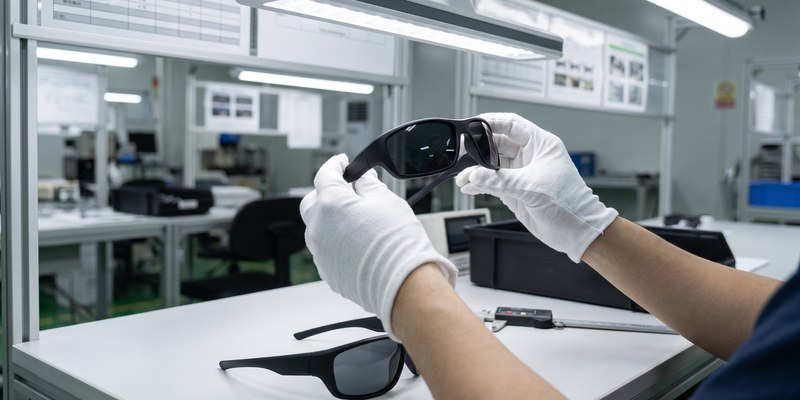
Eyewear Quality Control: How Defects Are Caught Before They Reach Your Customers
Every brand asks about price and lead time. Fewer ask how quality is actually controlled — and that's the question that determines your return rate, your reviews, and whether your second production run looks like your first.
Quality control in eyewear isn't a single inspection at the end. It's a series of checkpoints running from incoming raw material to the sealed carton. Here's how the process works, what gets caught at each stage, and what you should require from any manufacturer.
Why Final Inspection Alone Isn't Enough
The most common misconception is that QC means checking finished goods before shipping. By then, a systemic problem has already been replicated across your entire order.
If a mold is running slightly out of tolerance, or an incoming resin lot has excess moisture, catching it at final inspection means scrapping thousands of units. Catching it at the first article means adjusting a machine setting. Real quality control is distributed across the process — which is why in-house production matters so much, as a factory that controls its own manufacturing can stop a line mid-run, while one subcontracting the work finds out weeks later.
The Inspection Stages
Incoming material inspection (IQC). Raw materials are verified before they enter production — resin grade and lot consistency, lens blanks, hinges, screws, and rubber components. Material problems that slip through here surface as defects nobody can explain later. This stage matters especially for nylon and other hygroscopic polymers, where moisture content directly determines whether a molded part is sound or full of internal voids.
First article inspection. Before a run goes to volume, the first parts are measured against the approved specification and the golden sample. Dimensions, color, surface finish, and fit are all checked. This is the cheapest possible moment to catch a problem.
In-process inspection (IPQC). Checks continue at intervals throughout the run — monitoring dimensional drift, surface defects, coating consistency, and assembly quality. Molds and processes drift over long runs; periodic checks catch drift before it becomes a batch.
Final inspection (FQC/OQC). Finished goods are inspected before packing: cosmetic appearance, function, alignment, lens fit and optical quality, logo application, and packaging completeness.
Laboratory validation. Running alongside these stages, physical and optical testing verifies performance against standard — impact, UV transmittance, abrasion, and environmental exposure. An in-house testing lab means this happens in parallel with production rather than weeks afterward.
Understanding AQL Sampling
Most eyewear inspection uses AQL — Acceptable Quality Limit — a statistical sampling standard (ISO 2859-1) that defines how many units to inspect from a lot and how many defects allow the lot to pass.
Defects are classified in three tiers:
- Critical — safety or compliance failures, such as inadequate UV protection or a lens that fails impact. Tolerance is effectively zero.
- Major — defects a customer would notice and return: misalignment, visible surface flaws, loose hinges, wrong color.
- Minor — small cosmetic imperfections unlikely to trigger a return.
Common consumer-goods levels are 2.5 for major and 4.0 for minor defects, with zero tolerance on critical — but the right numbers depend on your price point. A premium flagship frame warrants tighter limits than a promotional SKU.
The practical point for buyers: agree your AQL levels and defect classifications in writing before production, not after a disagreement. "Acceptable quality" means nothing until both sides define which specific flaws count as major.
The Defects That Actually Occur
Knowing what to look for makes you a better partner in the process:
Molding defects — sink marks (depressions where thick sections cooled unevenly), flow lines, weld lines where material fronts met, short shots, flash at the parting line, and warping. Most trace back to material moisture, temperature, pressure, or cooling.
Lens defects — surface scratches, optical distortion, coating flaws such as pinholes or uneven mirror deposition, delamination, and polarization axis misalignment (which produces the classic uneven-darkness effect between left and right lens).
Assembly defects — misaligned frame fronts, asymmetric temples, hinge tension too loose or too tight, screws not properly seated, adhesive residue.
Cosmetic and finish defects — color deviation between components or batches, uneven texture, logo misprinting or misalignment.
The Golden Sample: Your Reference Point
Everything above depends on having an agreed standard to measure against. The golden sample — the approved, signed-off unit from the development process — is that reference. It defines what "correct" means physically, not verbally.
Alongside it, a good manufacturer maintains defect limit samples: physical examples showing the boundary of acceptable and unacceptable for common cosmetic issues. A photo of a surface flaw is arguable; a physical limit sample isn't. If you're specifying a premium line, ask for these — they eliminate most quality disputes before they start.
What to Require From Your Manufacturer
Concrete asks that separate serious partners from the rest:
- A documented QC plan covering each inspection stage, not just final
- Agreed AQL levels and defect classification in writing
- Golden sample and defect limit samples retained by both parties
- Inspection reports with quantified results, not a pass/fail line
- Traceability — the ability to link a batch back to material lot and production date
- A stated corrective action process for when something does go wrong
- The right to third-party inspection if you want independent verification
That last point is worth emphasizing: a manufacturer confident in its process has no objection to your inspector visiting. Hesitation there tells you something.
Where Tony Optical Fits
Quality systems are built over decades, not quarters. Our production operates under an ISO 9001:2015 certified quality management system, with inspection at incoming material, first article, in-process, and final stages, backed by our own testing laboratory for physical and optical validation.
For brands producing sports eyewear, that means defects are caught where they're cheapest to fix — and that the certification documentation behind your product is verifiable rather than asserted.
Frequently Asked Questions
What does AQL mean in eyewear manufacturing?
Acceptable Quality Limit — a statistical sampling standard defining how many units are inspected and how many defects allow a lot to pass. Levels are agreed between buyer and manufacturer before production.
What is a golden sample?
The approved, signed-off reference unit that defines correct appearance, dimensions, and function. Every production unit is measured against it.
Is 100% inspection possible for eyewear?
Yes for certain checks, and it's common for premium lines and for critical safety characteristics — but full inspection of every attribute is slow and costly, which is why AQL sampling is standard for most cosmetic and dimensional checks.
Can I send my own inspector to the factory?
A reputable manufacturer will accommodate buyer or third-party inspection. Agree access and timing in your production terms up front.
What's the difference between quality control and certification testing?
QC verifies that units match the approved specification. Certification testing verifies the product meets a regulatory standard for its market. You need both — they answer different questions.
Who pays for defective units?
This should be defined in your production agreement before the order, including how lots that fail AQL are handled — sorted, reworked, or replaced.
Final Thoughts
Quality isn't inspected into a product at the end; it's built in at every stage and verified along the way. Brands that define their standards clearly, agree AQL levels in writing, and work from a physical golden sample get consistent product. Brands that leave "good quality" undefined discover what it meant to their supplier only after the container arrives.
Planning a production run? Get in touch with our team to discuss our quality control process and the inspection standards for your project.


Article Classification
Recent Articles
- Custom Logo Sunglasses: Branding Methods for Private Label
- Eyewear Quality Control: Inspection, AQL & Defect Standards
- Eyewear Product Development: From 3D Design to Production
- How to Choose a Sports Sunglasses Manufacturer (B2B Checklist)
- Inside Eyewear Manufacturing: From Raw Material to Finished Product