0
0


- Home
- Blog
- Industry Insights
- How to Start Your Own Sunglasses Brand: MOQ, Costs & Timeline
How to Start Your Own Sunglasses Brand: MOQ, Costs & Timeline
How to Start Your Own Sunglasses Brand: MOQ, Costs & Timeline Explained
Starting an eyewear brand looks simple from the outside: design a frame, find a factory, sell it. In practice, the gap between a good idea and a first production run is where most brands stall — usually because nobody told them what to expect on minimums, costs, or how long any of it actually takes.
This guide walks through the process from a manufacturer's side of the table: the real decisions, the realistic timelines, and the questions worth asking before you commit to anything.
Step 1: Decide What Kind of Brand You're Building
Before you contact a single factory, get clear on three things. Every quote you receive will depend on them:
- Your category. Performance sports eyewear, lifestyle frames, and safety eyewear have different requirements, materials, and cost structures.
- Your price point. A $30 retail frame and a $150 retail frame are built differently from the first decision onward.
- Your market. Where you sell determines which certifications you need — and that isn't a detail you can add at the end.
Brands that arrive with these three answers get useful quotes quickly. Brands that don't tend to spend months in circles.
Step 2: Choose Between Stock Customization and Full Custom
This is the single biggest fork in the road, and it drives your MOQ, cost, and timeline more than anything else.
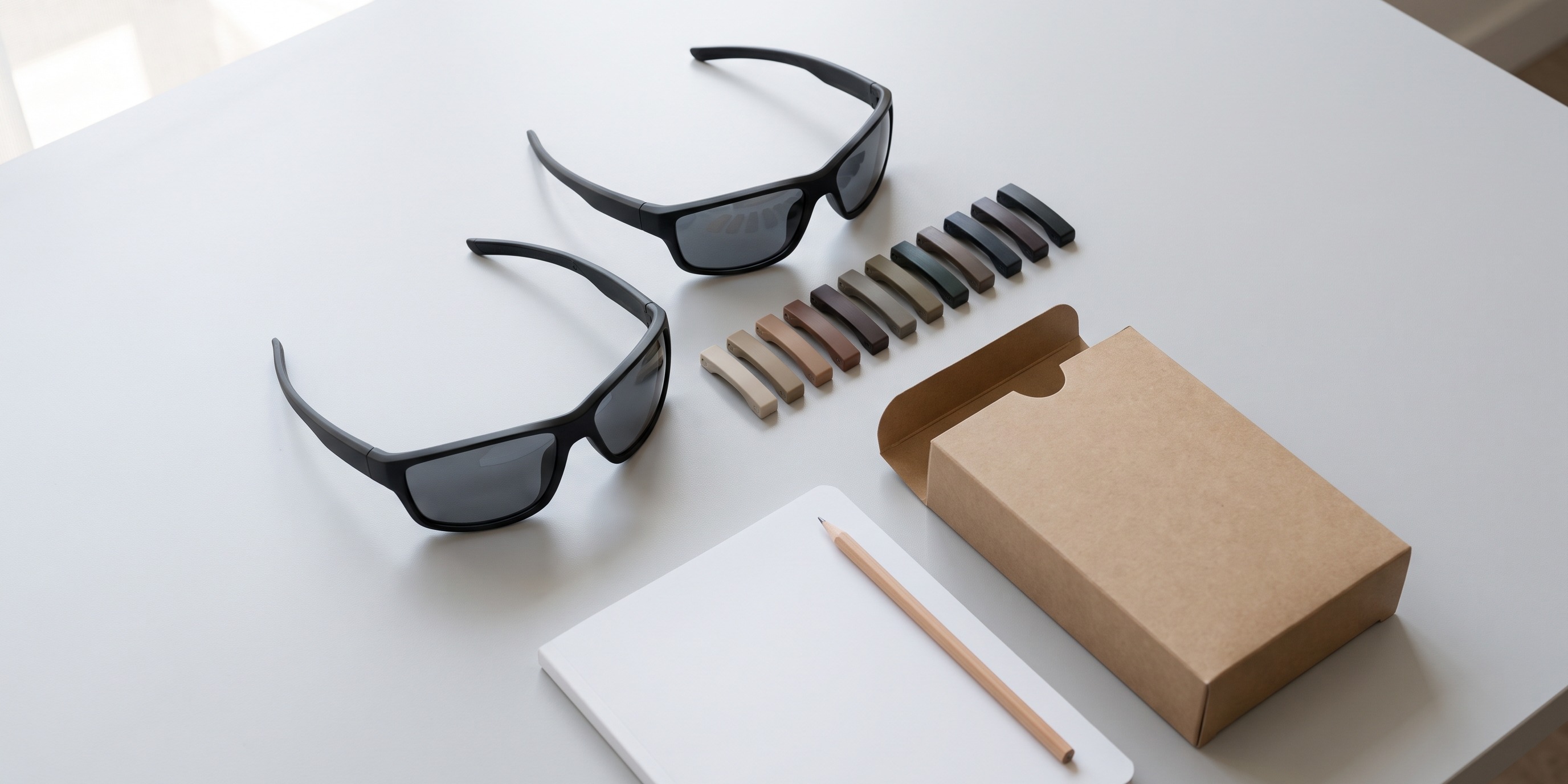
Stock frame customization means starting from a manufacturer's existing mold and making it yours — your colorways, your lens choice, your logo, your packaging. No tooling investment, lower minimums, and a much faster path to market. It's how most first-time brands launch, and there's no shame in it — plenty of successful brands never move past it.
Full custom development means an original frame built from your own design, which requires new molds. That means real tooling investment and a longer runway, but you get a shape nobody else can sell and a genuine design asset.
A practical approach: launch on customized stock frames to validate demand and generate revenue, then reinvest in custom tooling for your signature model once you know what sells.
Step 3: Understand MOQ
Minimum order quantity is the question every new brand asks first. The honest answer is that it depends on what you're making.
- Stock frame customization typically carries lower minimums, since no new tooling is involved.
- Custom molded frames require higher minimums, because the tooling cost has to be spread across the run.
- Per colorway matters too. An order is usually split across colors, and each color carries its own minimum — five colorways is a very different order than one.
Industry minimums for custom work commonly fall in the range of a few hundred units per style, though this varies widely by factory and project. Rather than fixating on the lowest number you can find, ask what's included at that number: does it cover lens options, custom packaging, logo application? A low headline MOQ with everything priced as an extra isn't the bargain it appears to be.
Step 4: Know Where Your Costs Actually Go
Your unit cost isn't one number — it's a stack of decisions:
- Frame material — PC, TR90, or nylon, each at a different price tier
- Lens specification — polarized, photochromic, mirror or Revo coatings all add cost
- Frame complexity — multi-component, adjustable, or interchangeable-lens designs cost more to produce
- Finishing — rubber components, custom colorways, and surface treatments
- Packaging — cases, cloths, boxes, hang tags
- Tooling — a one-time cost for custom molds, amortized across your production
Beyond the factory quote, budget for what comes after: shipping, import duties, certification testing, and your own branding and photography. Landed cost, not unit cost, is what determines your margin.
Step 5: Build a Realistic Timeline
Timelines vary by project, but the sequence is consistent. Plan for these phases:
- Concept and specification — defining the product with your manufacturer
- Design and 3D development — turning the brief into a producible design
- Prototyping and sampling — reviewing physical samples, usually across more than one round
- Tooling (custom projects only) — mold production, the longest single phase
- Certification testing — compliance for your target markets
- Mass production — the actual run
- Shipping and customs — sea freight takes weeks, not days
Stock customization can move quickly. Full custom development with new tooling takes considerably longer. The most common planning mistake is budgeting only for production and forgetting that sampling rounds, testing, and freight often add up to more time than manufacturing itself. Build in buffer — especially if you're targeting a seasonal launch.
Step 6: Don't Treat Compliance as an Afterthought
Sunglasses are regulated products, and requirements differ by market — EN ISO standards in Europe, ANSI in the US, plus sport-specific standards for protective eyewear. Getting this wrong after production means an unsellable inventory.
Confirm early that your manufacturer holds relevant certifications and can test to the standards your market requires. Factories with an in-house testing lab catch problems before mass production rather than after.
Step 7: Choose the Right Manufacturing Partner
Your factory choice shapes everything downstream. Look for a partner who manufactures in-house rather than brokering your order, advises you on materials instead of just taking instructions, communicates clearly, and can support you as your volumes grow. Our B2B buyer's checklist covers what to evaluate in detail.
It's also worth asking where they produce. With tariffs affecting landed costs significantly, a manufacturer with a diversified China–Vietnam footprint can give you flexibility that a single-country factory can't.
Common Mistakes First-Time Brands Make
- Designing without input from a manufacturer. Beautiful designs that can't be molded cost months to fix.
- Skipping physical samples. Renders don't tell you how a frame feels or fits.
- Ignoring certification until the end. This is the mistake that kills entire production runs.
- Over-ordering colorways. Every extra color multiplies your minimum and your inventory risk.
- Choosing purely on price. The cheapest quote often costs the most once quality issues and delays surface.
Final Thoughts
Launching a sunglasses brand is very achievable — thousands of brands do it — but it rewards preparation. Know your category, your price point, and your market. Decide honestly whether you need custom tooling or whether customized stock frames get you to market faster. Plan a timeline with real buffer. And choose a manufacturing partner who treats your first order as the start of something rather than a transaction.
With over 50 years of eyewear manufacturing across three generations, we work with brands at every stage — from first-time launches on customized stock frames to fully custom OEM/ODM development.
Ready to start your eyewear brand? Get in touch with our team — tell us your category, price point, and target market, and we'll walk you through MOQ, costs, and timeline for your specific project.